- Occupy thyself with few things, says the philosopher, if thou wouldst be tranquil.—But consider if it would not be better to say, Do what is necessary, and whatever the reason of the animal which is naturally social requires. For this brings not only the tranquillity which comes from doing well, but also that which comes from doing few things. For the greatest part of what we say and do being unnecessary, if a man takes this away, he will have more leisure and less uneasiness. Accordingly, on every occasion a man should ask himself, Is this one of the unnecessary things? Now a man should take away not only unnecessary acts, but also unnecessary thoughts, for thus superfluous acts will not follow after.-Thoughts of Marcus Aurelius (p. 30). Kindle Edition.
This is a continuation of a series of posts about my Foxtail Agave project. The previous post can be found here.
Setting time free
The need to simplify one’s life to free time is a recurrent theme in the stoic literature. And what do we need time for? Well, according to the stoics, to learn about, meditate on and incorporate the stoic precepts in our daily conduct.
Minimalism as a philosophy o life
“Minimalism” has gained a lot of traction in modern culture, from the arts to daily living and figuring out how much one really needs to be able to live a fulfilling life.
The concept of minimalism as a way of life has been around for centuries, with examples of minimalist living practices found in various cultures and religions throughout history, as exemplified by the stoic quote above, dating back to Jesus’ times.
The modern western minimalist movement began to emerge in the late 2000s and early 2010s, after the publication of books such as “Simplify Your Life” by Elaine St. James and “The Simple Living Guide” by Janet Luhrs. These books introduced the idea of living with less as a way to reduce stress and increase happiness.
In 2010, Joshua Fields Millburn and Ryan Nicodemus started their website The Minimalists, which quickly gained a large following and helped to popularize the concept of minimalism as a way of life. They published several books and created a documentary film, “Minimalism: A Documentary About the Important Things,” which helped to further spread the message of minimalism.
Minimalism in the arts and photography
In the arts, “Minimalism” evolved and became popular in the 1960s, after the Black Paintings of Frank Stella were exhibited at the Museum of Modern Art in New York. It was popularized by artists such as Carl Andre, Dan Flavin, Donald Judd, Sol LeWitt, Agnes Martin and Robert Morris.
Minimalist art, originally, represented an attempt to establish that art has its own reality and does not need to portray something else (a landscape, a person, an animal, still life etc). The viewers are supposed to respond only to what is in front of them. If you are not familiar with the works of the artists mentioned in the paragraph above, do some research and you will see that their art was simple, and dominated by geometric shapes.
It is possible that minimalism in photography can be traced back to the 1970s, when a group of photographers known as the New Topographics began to reject the traditional, romanticized depictions of landscapes in favor of more objective, documentary-style images that emphasized the banal and the everyday. In the “New Topographics”exhibition’s catalog, curator William Jenkins described the photographs as “neutral” and “reduced to an essentially topographic state, conveying substantial amounts of visual information but eschewing entirely the aspects of beauty, emotion, and opinion.”
The connection between the New Topographics movement and minimalism is that both rejected the traditional ideas of beauty in art, and instead focused on creating works that were intellectually engaging and aesthetically austere, and were both part of a broader cultural shift towards simplicity that was taking place in the 1960s and 1970s. However, they seem to conflict in that minimalist art rejects depictions of reality whereas the Topographics movement embraces it.
Modern photographers have incorporated the idea of minimalism by trying to simplify their images to only include the “necessary” elements, use a lot of empty space around the subject, and tame the color palette.
The Foxtail Agave project
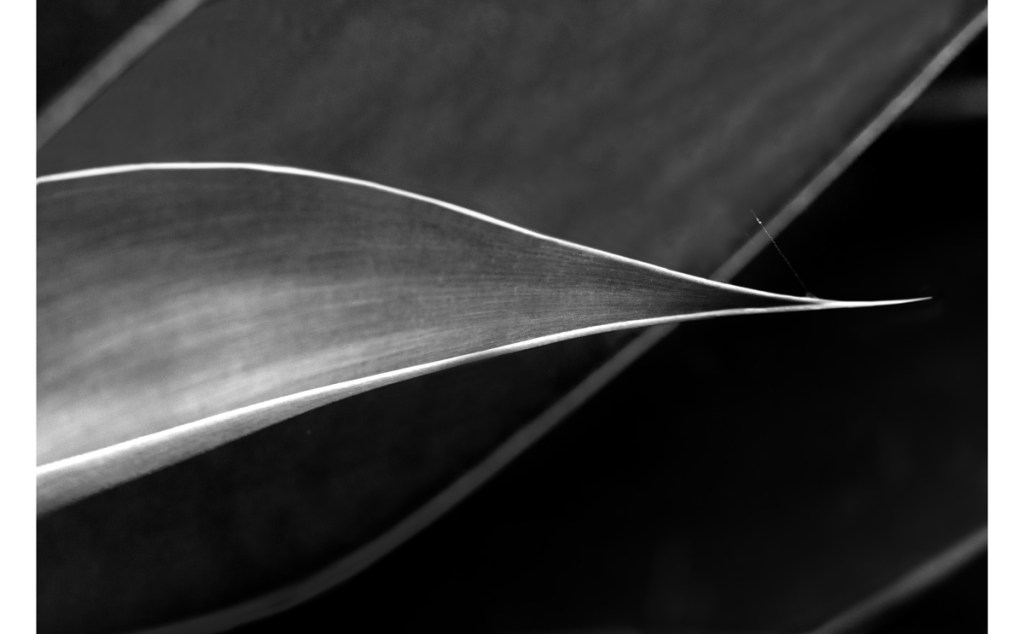
When I began photographing the Foxtail Agave , I had a vision that I was going to start from the overall form of the plant, then zoom in for details that became more and more abstract until the plant was no longer recognizable. Then I would ask myself, what are the minimal components of the plant that will allow the viewer to recognize it as an Agave (first); as a plant (second); then simply as abstract shapes (third)?
In my first post about this project, I showed the center of the Agave and in my second post, the whole plant as seen from above. In those photographs, the identity of the plant is recognizable. In my third post, I emphasized curves– maybe some people will also recognize the Agave in that photo because the center of the plant is somewhat visible.
And how about the FEATURED PHOTOGRAPH? When you look at it, do you still see the Agave, a succulent, just a plant,or a bunch of curves?(macro lens 105 mm Nikon, f/5.6, 1/400s, ISO 640. I don’t remember whether I used a tripod or not. Bonus: note the spider silk holding the tip of the leaf).
Wrapping it all up
Less can be more.
To be continued…
______________________________
Wall Art landscapes and miscellaneous
________________________________


 It is all about the light
Leave a reply to Minimalism in Monterey, California – It is all about the light Cancel reply