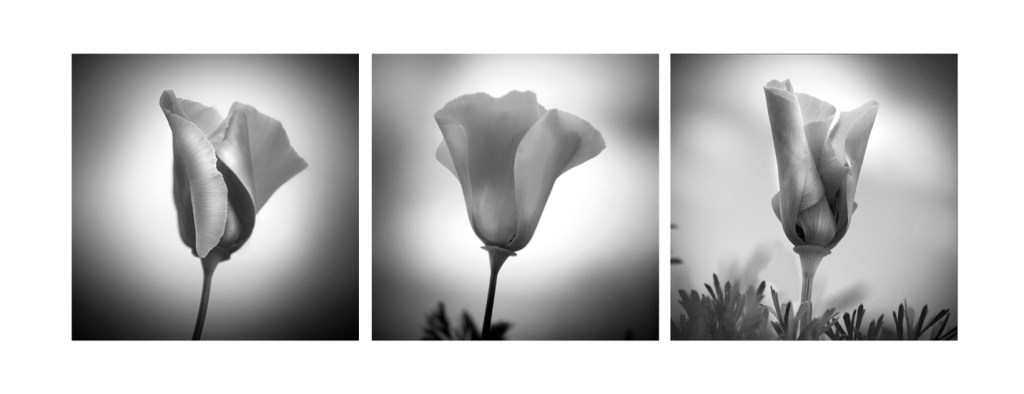
On a previous post last year, I wrote that I started and then gave up on a project portraying the closed flowers of the California Poppy, Eschscholzia californica. The original project was in color against a black background. Since that didn’t work out, I decided to take a few photos of those flowers against the sky, to convert them to monochrome later.
Photographing the entire flower against the sky takes the emphasis from the geometrical patterns (which I was having difficulties with) of the folded petals and puts the entire subject under the spotlight.
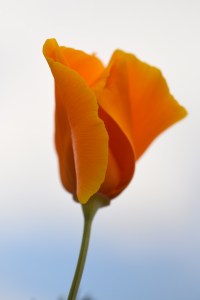
Because the flowers are completely orange in color, converting the photos to black and white was a real challenge: too little contrast.
After a few hours of great fun playing with black and white sliders, applying dogging and burning, contrast and levels in Photoshop, I came up with a few looks that I found interesting. I then added a strong vignette and some noise, and upped the contrast. That resulted in the photo below, and the featured trip·tych.

Working in Photoshop layers
I initially process my files in Photoshop’s Camera Raw, then I export them in color. Next, I process them in layers, as below. Working in layers allows me to make fine adjustments to my photo, while preserving the various stages of the post- processing.

The picture above is is a static view of a very dynamic process which I might write a post about at some other opportunity. These layers can be turned on and off. For example, if I later decide that I don’t want the added noise, I can turn the nose layers off.
To me, the featured images have a certain appeal which lies, in part, on their imperfections.
Wabi-Sabi
In his book “Wabi-sabi for Artists, Designers, Poets and philosophers” (imperfect publishing, Point Reyes, California), Leonard Koren takes us to the world of Wabi-Sabi. On the first paragraph of the introduction, he writes that “ wabi-sabi is a beauty of things imperfect, impermanent and incomplete”. He then writes a brief historical and cultural context trying to deepen our understanding of the term. More importantly, however, the book conveys the idea that it is very difficult to completely understand wabi-sabi outside the cultural context of the Japanese culture and language, leaving the reader with the wabi-sabi flavor of an incompletely understood word.
Although I’m attracted to the idea of incorporating imperfections in my work, I have a difficult time letting it go and embracing it. Modern photography is a lot about getting rid of imperfections: clipping, noise, vignette etc, and increasing detail, resolution and sharpness.
How about you, do you have a difficult time incorporating wabi-sabi in your artistic work?

———————————————
________________________________


 It is all about the light
Leave a reply to echidnaorangevarda3344 Cancel reply