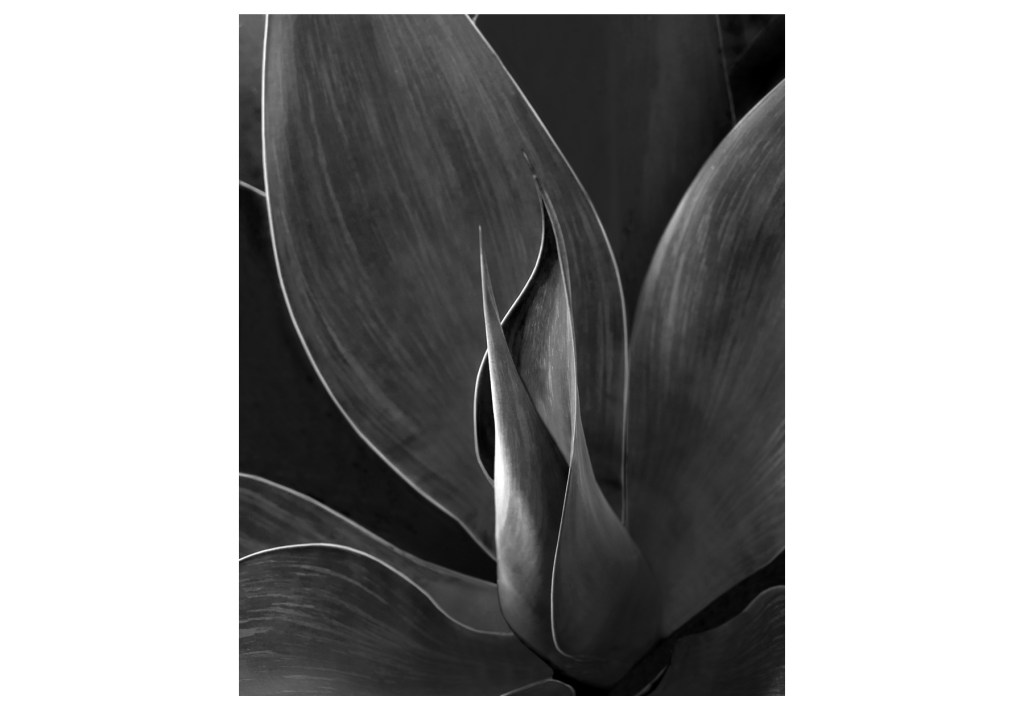
Happy new year from me to you… I hope my followers had a peaceful and enjoyable holiday season. This is my very first post in 2023, and in it I include an invitation for you to welcome the new year with a hint of stoicism (see below).
Over the holidays I started a new, short photography project: a study of the Foxtail Agave, Agave attenuata. The leaves of these succulent plants are curvy and have a particular way to harvest light. It was entertaining, trying to find different angles and perspectives with my camera, while I tried to distract my mind from the doom and gloom of the first holiday season after my husband’s death.
I took the FEATURED PHOTOGRAPH with a 50 mm mirrorless lens at f/6.3, shutter 1/250 s and ISO 350, handheld, on a cloudy day. It had rained, one important aspect of succulent plant photography. The rain washes the significant amount of dirt these plants tend to accumulate on their leaves, making it possible to take photographs that are free of unwanted distractions. If you follow me on facebook, you have already seen this photo.
Photographing in projects
A photography project, as I understand it, is a somewhat unified, cohesive body of work that employs the same concept, technique, subject, and or palette throughout multiple photographs. Working in projects can be an excellent way to improve one’s skills and explore a particular theme or style in greater detail. It also helps the photographer to remain focused and avoid being pulled in various directions like a leaf in the wind.
If you are interested, my previous posts about working in projects can be found on this link, and my previous image projects are displayed on my Adobe Portfolio.
Inspiration in “ócio”
I dedicated some of my free time over the holidays to read a book by the Roman philosopher Seneca “On the Shortness of Life”. Seneca argues that life is long enough if we maximize our time in “otium” (Latin). Life is only short – he writes- for the busy person, who forgets about one’s own own mortality and goes on existing for the future, while engaging in futile endeavors that waste away the time one has to live.
It takes the whole of life to learn how to live, and—what will perhaps make you wonder more—it takes the whole of life to learn how to die.
Seneca
In Portuguese, the language I read the book, “otium” was translated as “ócio”, which primarily implies “wasting time”, or “doing nothing productive” with one’s time. The term is often applied to lazy people. I believe that the word “leisure”, in the English translation, expresses more accurately the meaning the philosopher tried to convey, as being the best way to spend one’s time.
Undeniably, Seneca was a busy man most of his life. He was involved in significant intrigue, manipulation, and power struggle, typical of the Roman Empire, which he effectively administrated for several years on behalf an immature Emperor, Nero. Seneca most likely explored his stoic philosophical ideas when he was in exile and wrote his books in the end of his life, when the Emperor denied him retirement from his administrative duties and ordered him to live in semi-reclusion.
Inspired by the book, I decided to spend my vacation in “ócio” and explore the dual meaning of the concept. I read the book a few times, to improve myself through the study of (stoic) philosophy; but I also started a new image project, to waste my precious, mortal time, on a futile endeavor.
Reference: On the shortness of life, by Lucius Seneca. (link for informational purposes only, not affiliated.
Below, a photo of my edition, in Portuguese and Latin.

______________________________
Wall Art landscapes and miscellaneous
________________________________


 It is all about the light
Leave a reply to gsilvosa63 Cancel reply