
This is the third of a series of posts about photographers whose work and life I find inspiring. The spotlight is on Karl Blossfeldt, a German photographer from the late 1800s, early 1900s, who built his own camera. Previously, I wrote blog posts about Charles Jones and Kazumasa Ogawa.
Exploring the photography and life of Blossfeldt now seems fitting, since I have decided to explore botanical photography on a white background in my own work this summer.
Karl Blossfeldt, a name synonymous with the intricate beauty of nature, stands out as a pioneering figure in the world of photography. His work, characterized by stunningly detailed images of plants and flowers, continues to inspire photographers, artists, and nature enthusiasts alike. Blossfeldt’s unique approach to botanical photography not only showcased the artistic potential of natural forms, but also revolutionized the way we perceive and appreciate the subtleties of the natural world.
The Man Behind the Lens
Born on June 13, 1865, in Schielo, Germany, Karl Blossfeldt initially pursued a career in sculpture. His fascination with nature was evident from the beginning, as he believed that the forms found in the natural world could serve as a foundation for artistic expression. This belief led him to the Royal Museum of Arts and Crafts in Berlin, where he studied and later taught.
Blossfeldt’s transition from sculpture to photography was driven by his desire to document and study the intricate details of plants. This dual purpose—scientific documentation and artistic exploration—set the stage for his groundbreaking work in botanical photography.
A New Perspective on Nature
Blossfeldt’s photography is distinguished by its meticulous attention to detail. Using a homemade camera capable of magnifying objects up to 30 times their actual size, he captured the minute structures of plants with unparalleled clarity. His black-and-white photographs highlight the geometric patterns, textures, and symmetries that are often overlooked by the naked eye.
One of the most striking aspects of Blossfeldt’s work is his ability to transform ordinary plants into extraordinary works of art. By isolating his subjects against plain backgrounds and focusing on their structural elements, he drew attention to the aesthetic qualities of nature. This approach not only emphasized the beauty of botanical forms but also underscored their architectural and sculptural potential.
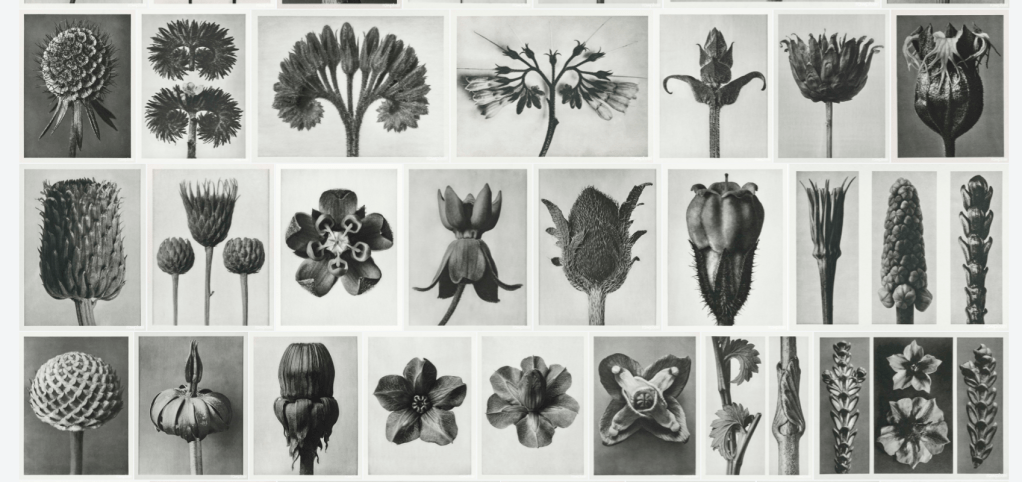
Click on the image above to see larger versions of Blossfeldt’s photographs in the public domain.
The Legacy of Blossfeldt’s Photography
Blossfeldt’s photographs were first published in his seminal book, Urformen der Kunst (Art Forms in Nature), in 1928. The book was an instant success, captivating both the scientific community and the art world. Its influence extended beyond photography, inspiring artists, designers, and architects to explore natural forms in their work.
Today, Karl Blossfeldt is celebrated as a master of botanical photography. His work continues to be exhibited in galleries and museums worldwide, reminding us of the intricate beauty that surrounds us. Blossfeldt’s legacy endures not only in his captivating images but also in the way he bridged the gap between science and art, encouraging a deeper appreciation for the natural world.
Conclusion
Karl Blossfeldt’s photography invites us to see nature through a different lens—one that reveals the complexity, elegance, and artistry inherent in every plant. His work serves as a testament to the beauty of the natural world and the power of photography to transform the ordinary into the extraordinary.
Blossfeldt’s photographs remind us of the importance of preserving and cherishing the delicate beauty that nature offers. Through his lens, we are reminded that there is much to discover and appreciate in the world around us, if only we take the time to look closely.
______________________________
Wall Art landscapes and miscellaneous
________________________________


 It is all about the light
Leave a reply to Alessandra Chaves Cancel reply