
I’ve been wanting to write about ‘clouds’ for some time. Though we don’t often see many clouds around here, they make their occasional appearance, driving photographers into a frenzy of landscape photography.
Whenever clouds grace the sky, local photography groups and friends’ social media feeds overflow with posts capturing the moment. Yet, I often find myself pondering: when do clouds enhance the narrative of a photo?
More often than not, clouds don’t help
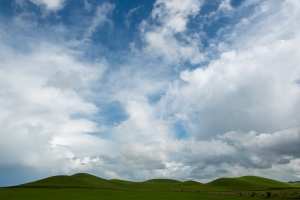
While clouds can add a welcomed dimension to a landscape, at times, they serve only to confuse or distract. Take, for example, the photograph below, taken on 03/23/2024, at Rush Ranch in Fairfield. What is this photo about? Is it about the green, rolling hills, or the messy sky?
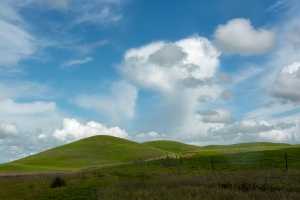
On the same day, the captivating play of light on the mountains caught my eye and led me to capture the moment. However, upon returning home, I realized that the clouds, though foreboding, clashed with and detracted from the focal point I intended to showcase.
One strategy for dealing with strange-strange-shapped clouds that cause visual confusion rather than enhance the landscape is to shift the focus of the photograph to emphasize the cloud formations. The photo below is a crop of an image taken a few minutes after the image above, when the cloud was more dense. At least in this case, the viewer knows what he is looking at. Converted to black and white, the shape of the cloud is emphasized.
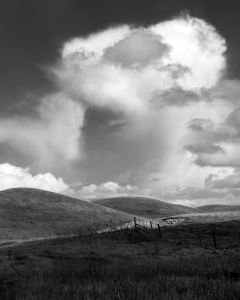
When I encounter an intriguing cloud formation that doesn’t harmonize with the scene but rather competes with it, I opt to center the photograph around the cloud itself. In the example below, the angelic silhouette of the cloud inspired me to capture the moment. Including the landscape would have only created confusion. This photograph was initially featured in my blog post ‘You Look Like an Angel: A Cloud Formation in the Sky Above.’”
Omnious skies
An ominous sky can dramatically alter the mood and atmosphere of a landscape, but it also presents challenges for photographers. While such skies can add a sense of drama and intrigue, they often overshadow or obscure the intended subject of the photograph. The dark and brooding clouds, coupled with dim lighting, can make it difficult to highlight key elements in the scene, leading to a loss of clarity and focus. As a result, photographers must carefully consider how to navigate and work with these atmospheric conditions to ensure that the subject remains prominent and discernible amidst the ominous backdrop.
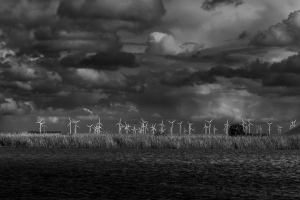
Sometimes, as in the case below, a photograph taken on 03/23/2024 at Grizzly Island, going back to the scene for another shot might be the best solution. I wanted to emphasize the windmills of the Central Valley, but no matter how much I spin it, the ominous sky dominates, and the interface of whites and blacks created by the clouds has resulted in a busy frame.
Somewhere over the rainbow
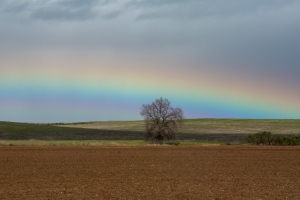
My photo buddy and I were excited to encounter this rainbow scene on a county road, but the clouds were there to “steal the thunder”.

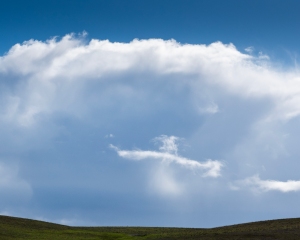
A different approach using a long lens, yielded better results when the clouds were excluded.
Conclusion:
Distracting cloud formations, ominous skies and clouds surrounding a rainbow sometimes ruin landscape photography. It behoves the photographer to look for angles, lenses and crops that will simplify the scene and guide the viewers’ eye. If a compromise cannot be found, coming back to the scene on another day is better than showing a frame that is both busy and confusing.
In “Clouds, part II”, I will discuss and show examples of clouds that either complement or at least are neutral in the landscape. Stay tuned!
—————————————–———————————————
—————————————–———————————————


 It is all about the light
Leave a reply to shoreacres Cancel reply