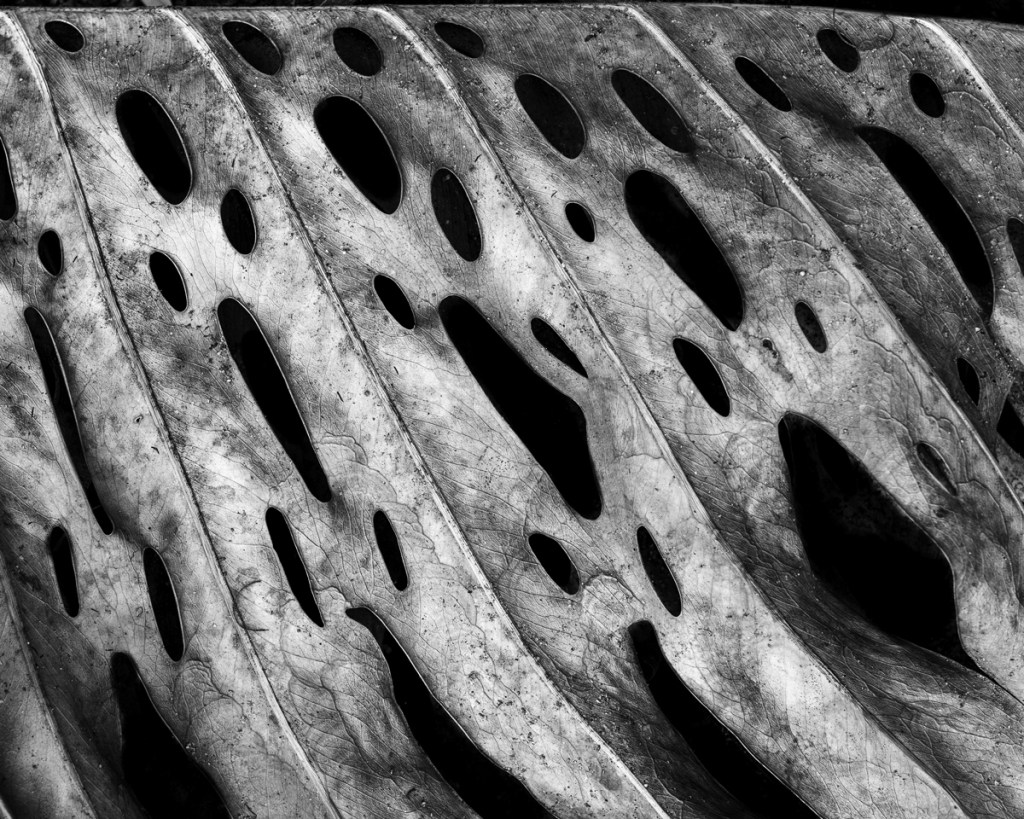
Last year I posted about a photograph of the dry leaf of Monstera deliciosa I had prepared for my joint show with my friend Beth. That photo (below) ( f/10, 1/200, ISO 800, @ 105 mm) portrayed a dorsal view of the leaf.
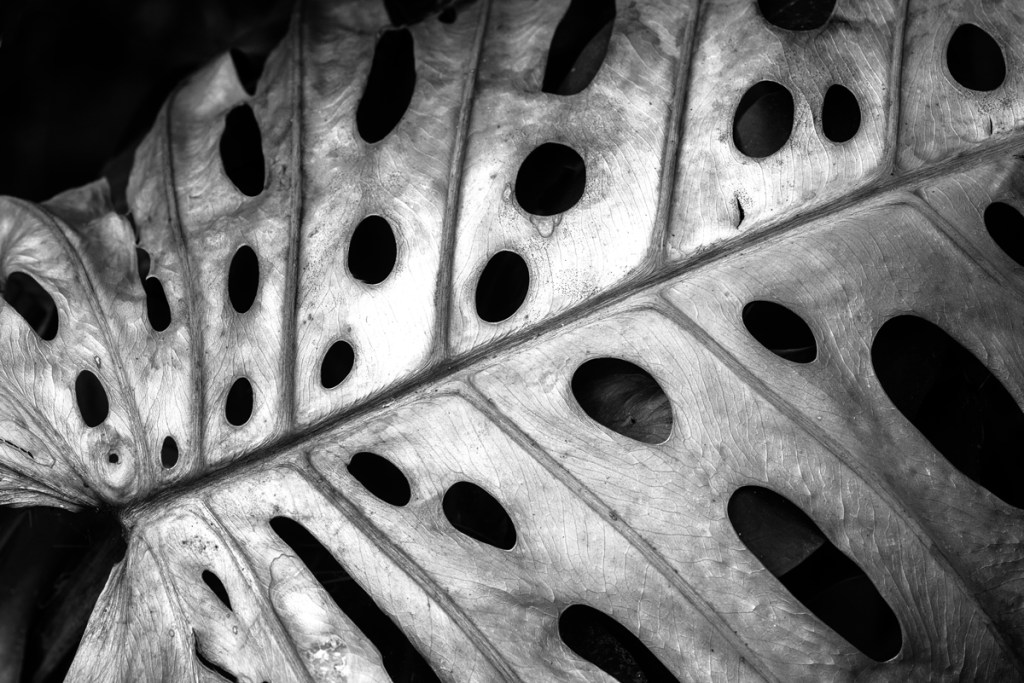
Last December, during a trip to Brazil to visit family, I set out to make another photograph, a side view of the leaf (featured photograph: f/5.6, 1/68, ISO 640, 60 mm).
Both images were taken in the field. Notice the fairly different settings and focal lengths, yet the results are not all that different. Photographers often want to know which camera, lens, or settings were used, assuming this information will help them recreate a particular look. In reality, the same visual effect can be achieved in many different ways.
Both images have been added to my GeoGalleries portfolio “leaf“.
Commonly known as the Swiss cheese plant, Monstera deliciosa is a popular tropical houseplant prized for its large, glossy, and uniquely perforated leaves. Native to the rainforests of Central America, it thrives in warm, humid environments and can grow impressively large, both indoors and outdoors. In the wild, its aerial roots allow it to climb trees, while its leaves develop characteristic fenestrations as the plant matures, enhancing its striking appearance. Beyond its ornamental appeal, it also produces an edible fruit with a flavor reminiscent of pineapple and banana. Easy to care for, it prefers bright, indirect light and well-draining soil, making it a favorite among plant enthusiasts.
What’s in the name
Monstera deliciosa was named by the Danish botanist Frederik Michael Liebmann (October 10, 1813 – October 29, 1856). Species names are binomial, meaning they consist of two parts: the genus name, which is capitalized, and the species epithet, which is not. The binomial is often followed by the name of the person who described the species (Liebmann, in this case), and sometimes the year of description. Scientific names are typically written in italics (or bold) to distinguish them from the rest of the text.
The name Monstera deliciosa comes from Latin and reflects both the plant’s appearance and its fruit. Monstera is derived from monstrum, meaning “monster” or “monstrous,” referring to the plant’s large, unusually perforated leaves. Deliciosameans “delicious,” a nod to the fruit, which, when ripe, has a sweet, tropical flavor reminiscent of banana, pineapple, and mango.
______________________________
Wall Art landscapes and miscellaneous
________________________________


Leave a Reply