Subtitle: Leading lines and repeated patterns in landscape
Back in 2023, I wrote two posts about my project to photograph California’s Central Valley, “The gate is locked – the beauty and bleakness of California’s Central Valley- a new project”, and The beauty and bleakness of California’s Central Valley- part two. In January of this year, I published The beauty and bleakness of California’s Central Valley- part three. I was excited to share images taken at the Rush Ranch in Fairfield, nested along Grizzly Island Road and the Suisun Marsh. I also reported that I had decided to go with the 2X3 aspect ration for my series.
There is more to the Central Valley than Fairfield, much more
In the end of the winter, countless photographers and amateurs with their cell phones drive on our flat, narrow roads, looking for opportunities to photograph the incredible display of Almond blossoms.
The Central Valley is home to a number of almond orchards. Take a look at the linked map to have an idea. The region where I live and photograph corresponds to the upper cluster above the San Francisco Bay.
Friction between photographers and property owners
In the Sacramento Valley, photographers and property owners are not always the best friends. Frictions tend to happen when it is time for almond blossoms, mustard blossoms, and sunflower blooms. It is important to respect the limits of private property, pull out and park only when and where it is safe to do so, and if models or photoshoots are planned, it is crucial to ask for permission and offer the owner compensation for trespassing. Regardless of permission, however, it is always a good idea to not destroy anything, restrain from picking blossoms, and be careful not to trample over the irrigation system in orchards.
The FEATURED PHOTOGRAPH and tips on composition
Photographing the landscape of the Central Valley is not easy, since there is little in the way of redeeming beauty and anchor points (subjects). In the first two posts referenced in the first paragraph, I presented photographs that had a clear subject (a gate, and a cow), and the third one was all about leading lines.
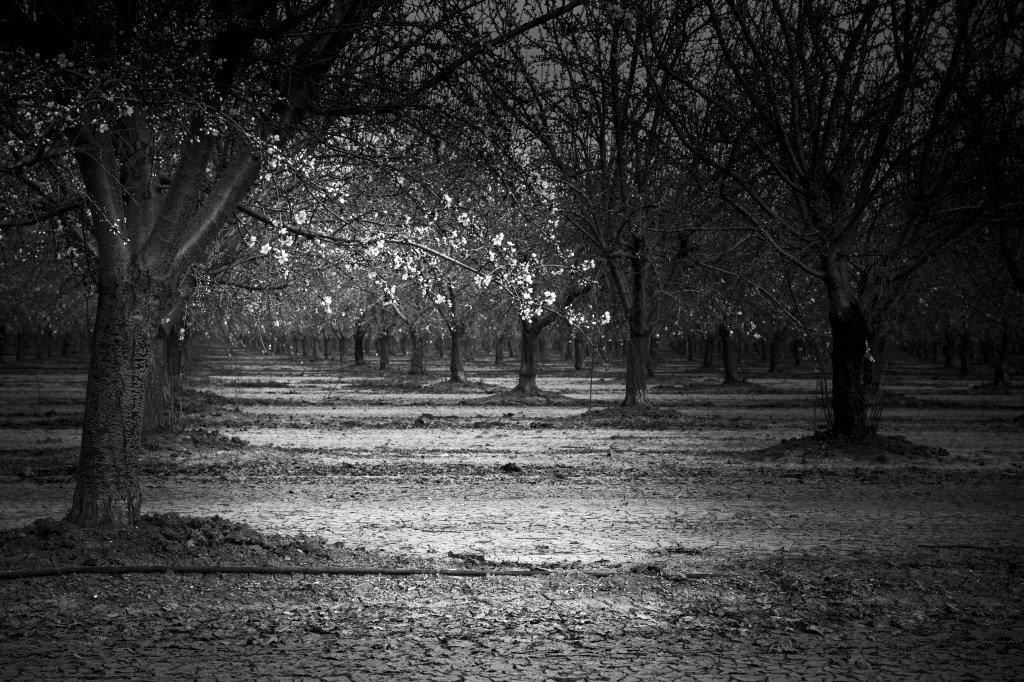
The composition in this post is anchored on a repeated pattern and leading lines. In the absence of a distinct subject, lines can be employed in landscape to create a narrative through their intrinsic geometry and depth. In the FEATURED PHOTOGRAPH (f/9 1/200s, ISO 320 at 24mm) of the almond orchard, repeated below for convenience, the repetitive pattern of the trees forms striking leading lines in the composition. Each tree’s slender trunk creates a rhythm that guides the viewer’s eye through the scene with precision. This organized arrangement not only captures the eye but also invites contemplation of the natural order within the landscape. Manipulating the light, I also constrained the path of the viewers eye to a narrow bright area.
Mockup rooms in Photoshop
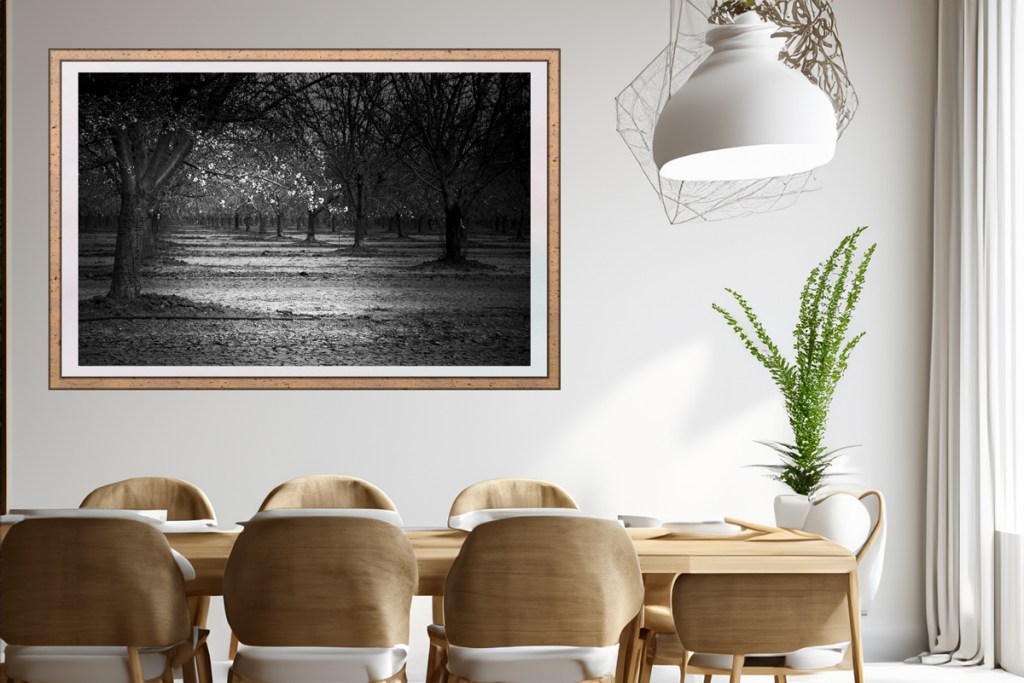
Photoshop now allows us to create mock-up rooms to display our art using generative fill. I have fun creating rooms and then placing my photograph in them, trying to imagine how it would look on someone’s walls. If you are unfamiliar with Generative Fill and want an introduction to it, ADOBE has a set of great tutorials.
______________________________
Wall Art landscapes and miscellaneous
________________________________


 It is all about the light
Leave a reply to tierneycreates: a fusion of textiles and smiles Cancel reply