Monterey Trees, part three- youth

Published by

on

In the beginning of February, 2021, I spent two days in Monterey, where I took four photographs that are now included in my small Monterey Trees series. One of them is the featured photo. I took it at Monterey’s Fort Old Dunes State Park. I wrote a previous blog post (Monterrey Dreaming) about Monterey Trees, where I explain in more detail how I process my photos, and how they deviate from my usual work in that I apply a texture and a tone to my images.

BEAUTY OF YOUTH

Although the Monterey Trees series is centered on the concept of resilience, defined as “the process of adapting well in the face of adversity, trauma, tragedy, threats, or significant sources of stress”, and most of my subjects display scars left in them by difficult conditions, I thought I should include at least one subject that looks yet untried by life’s difficulties.

The conditions in Monterey County are harsh on trees. The relentless wind, thin soil, and salt from the ocean, are challenges that the Monterey Cypress, among other local trees, have endured in the course of their evolutionary histories. More recently, the resilience of these local trees has been further challenged by drought, bark beetle infestations and urbanization, all of which have contributed to the death of many cypresses. Sadly, scientists have predicted that most of the still living Cypress trees of Monterey will be dead within the next 20 years.

The tree in the featured image, although very close to the beach and along a bike and pedestrian path and the street, looks very healthy and pompous, defying the local conditions. It reminds me of young people, full with energy and beauty in form, even though sometimes they don’t treat their bodies very well.

“Youth is lost on the young”.

Despite the fact that the tree looks healthy, one can notice that the branches are growing asymmetrically on the tree, suggesting that the wind blows harder from the left to the right side of the frame.

POPULARITY

If social my media feedback is a sample from which I can draw provisional conclusions, my collection of images in Monterey Trees is the least favored by the public. I have fun trying to find more subjects for this project, and figuring out how to properly photograph each one. Throwing your work out there to risk having it rejected is not easy, and every artist, wether publicly acclaimed or self-proclaimed, needs a good deal of resilience to persevere, and courage to learn and grow from one’s failures.

TEST PRINTS

The test prints for this series look beautiful on Hahnemühle papers with a warm tone and some texture. A fellow blogger (thank you, Howard) did a test print of one for me on Hahnemühle Museum Etching, which I liked very much. But since this paper is not widely available, I tested-printed a few of the other photos on Hahnemühle William Turner, Photo Rag, and also on canvas. They all look excellent to me. I ordered one print sample on William Turner with deckled edge. I wanted to see how it looks like. I like the finish and I think that it agrees well with the “spirit” of the collection.

In a previous blog post titled “Monterrey Dreaming,” I provided more detailed explanations about my process of photo editing for the Monterey Trees series. Unlike my usual work, these images deviate by incorporating texture and tone.
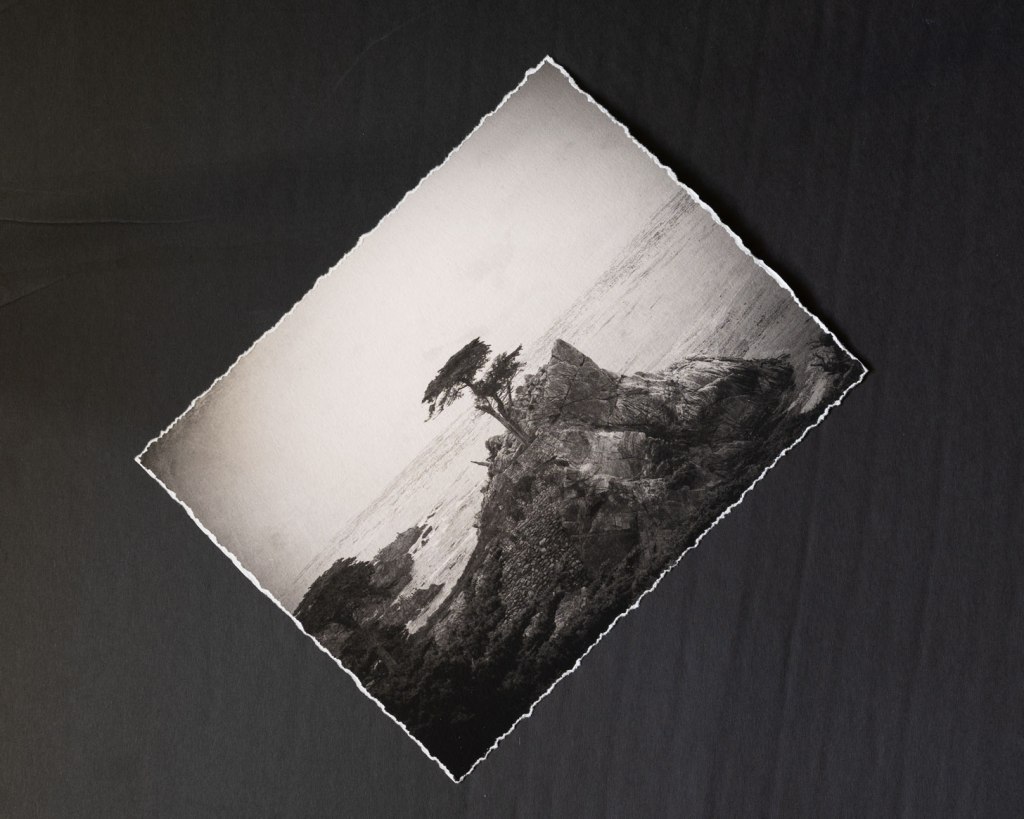
Click on the link to see the rest of my Monterey Trees image series.

RESOURCES

A follower posted a comment with a link, on my last post about Monterey Trees. The link is to a poem (with an accompanying picture) in a magazine, published in 1914, about a windswept tree in WY. I’m happy to know that a century ago someone saw what I see in those trees.

If you want to learn more about the Monterey Cypress, an endangered species, there is a good article on Wikipedia.

I have a few previous posts about photography projects and series, where I discuss the possible benefits of working that way and some difficulties I have encountered in my own work.

______________________________

Wall Art Botanical Images

Wall Art Photography projects

Wall Art landscapes and miscellaneous

________________________________

25 responses to “Monterey Trees, part three- youth”

  1. Antonio Mozeto Avatar

    Beaultiful piece of work, Alessandra! I always look for trees to photograph…but not every tree is ‘photographable’…yours in Monterey are beautiful in the sense that they are almost unique…I have just a few that fall into this category…I have a series called ‘standing dead trees’ that you might want to see on my website…

    Liked by 1 person

    1. Alessandra Chaves Avatar

      Thank you,I will look it up this weekend. The difficulty with trees is, isolating them from the background.

      Like

    2. Alessandra Chaves Avatar

      I enjoyed your series “ standing dead trees”, particularly the ones at the site of the The Tocantins River dam. You are absolutely right in that trees isolated from other trees have a lower chance of survival. Trees are connected underground through their roots and large fungi masses. Very sad.

      Liked by 1 person

  2. Antonio Mozeto Avatar

    Your texts are also always great…I always learn things from them…congratulations…

    Liked by 1 person

    1. Alessandra Chaves Avatar

      Obrigada.

      Like

  3. The Wheelchair Teen Avatar

    I’d never heard of Monterey Trees before so I learned a lot from this post. Maybe in 20 years after there are no more left, this picture will be seen as even more valuable. I love the way that you’ve captured. It almost looks more like a painting than a photograph.

    Liked by 1 person

    1. Alessandra Chaves Avatar

      Thank you. In 20 years I might be gone!

      Liked by 1 person

      1. The Wheelchair Teen Avatar

        😅

        Like

    1. Alessandra Chaves Avatar

      Thank you. Maybe one day, a Monterey trees quilt! 😎

      Liked by 1 person

      1. tierneycreates: a fusion of textiles and smiles Avatar

        That would be an awesome quilt!

        Liked by 1 person

      2. Alessandra Chaves Avatar

        Yes!

        Liked by 1 person

  4. Steve Schwartzman Avatar

    I’m sorry to hear scientists are predicting that most of the still living cypress trees of Monterey will be dead within the next 20 years. I photographed some when I last visited Monterey in 2016. The wind-caused asymmetry that you mentioned was noticeable there then.

    You raised the issue of popular reaction to your various photographs. A lot depends on the audience. I’ve noticed over the years that many people will ooh and aah over photographs that are technically poor. That has led me to conclude that most people aren’t sophisticated about photography—but then the same could be said about any field, not jut photography. Even among more sophisticated viewers of photographs, tastes of course vary a lot, at least in part influenced by recent trends. It’s good to get educated people’s opinions of our work, and those opinions may make us realize things of which we were unaware. Beyond that, though, we sometimes persist in valuing photographs that don’t move the majority of people.

    And now a specific question: what led you to apply textures in this series but not more generally?

    Like

    1. Alessandra Chaves Avatar

      What has led me to apply texture’s to those photos is isolation. I needed to isolate the trees and a blunt background looks boring. One day I came across a vintage filter from Topaz and after applying it I concluded that I liked the effect. I don’t feel the same need with regards to my other photos.

      As for praise from photographers, curators and other photography educated people it goes only so far. Although I like to hear their opinions, even when they are not compliments, they don’t buy anything and are often trying to do the same as I am, sell some prints or licenses 😅.

      Like

  5. howg2211 Avatar
    howg2211

    So sad to think that these trees may one day be gone. Beautiful images. I wouldn’t take likes on social media as equating with artistic quality, but I’m very sure you know that already.

    Liked by 1 person

    1. Alessandra Chaves Avatar

      It’s not likes. It’s “neversold” a print except for the lone cypress, which is famous and everyone knows it, but which I technically cannot sell images of because of a trademark.

      Like

  6. shoreacres Avatar

    The asymmetrical nature of your tree brought to mind the coastal oaks of the central and south-central Texas coast. Influenced by constant winds off the bays, they tend to be stunted as well as being canted to one side. Both aspects set them apart, and make them favorite subjects for photographers.

    I smiled at your comment about public reception of your work: whether positive or negative. Quite early on in my own little endeavors, I decided I was going to write about what interested me. If others found it interesting as well, that would be a wonderful ‘plus.’ If not? I wasn’t going to worry about it. Granted, that kind of detachment isn’t always easy to maintain, so every now and then I listen to Jimmy and Nadira making the point again, and smile at these lyrics:

    “He said, ‘The people only buy the love songs,
    Rock and roll and not too long.’
    He said, ‘Girl, you got to be commercial
    If you want to turn the people on.’

    And I said, ‘Turning on the people?
    Well, that’s a beautiful place to be.
    But if I spend all my time makin’ them up a rhyme,
    Well, who’s gonna turn on me?’”

    Liked by 1 person

    1. Alessandra Chaves Avatar

      Love the lyrics!

      Liked by 1 person

  7. Steve Gingold Avatar

    Very few artists, and photographers for sure, meet with grand acclaim for their work, especially when the subject matter is not “a pretty picture” by general standards. But when other photographers look at our work and praise it then you get a better grasp on how your work is truly perceived. And most accomplished photographers will say that they shoot for themselves and, when lucky, that work is enjoyed by others. It appears that the photographers who visit your blog are impressed with your work so you should be comfortable knowing that. COunt me in that group.
    I enjoyed the linked Portfolio of Monterrey Trees, my favorite being “Bonsai Cypress” which is quite inviting. Also, I received your book and enjoyed that as well.

    Liked by 1 person

    1. Alessandra Chaves Avatar

      Thank you. There are certain types of photos that are enjoyed by a larger audience. I’m fine with not being popular or acclaimed. I have a career in science, a good job to provide for my financial needs, and the certainty that life goes all too fast. In the big scheme of things, a lot of the stuff we give importance to, doesn’t really matter. I’m glad you enjoyed the book and thanks for giving it a try.

      Liked by 1 person

      1. Steve Gingold Avatar

        ” In the big scheme of things, a lot of the stuff we give importance to, doesn’t really matter. ” Yup, that’s why we shoot for ourselves. If we are happy making images and happy with how they turn out, that’s what it’s about. The rest is gravy.

        Like

  8. Florin Avatar

    I like the effect/mood imprinted by that background texture. What I like even more is working on picture sets or themes that we gradually add to. Will check out the rest of the Monterey Trees set.

    Like

    1. Alessandra Chaves Avatar

      I have found it very satisfying to work on projects, gives me a sense of accomplishment and helps me keep a consistent style (at least within the same project).

      Like

  9. Cyndy Avatar

    Glad to see a fellow Hahnemühle William Turner Photo Rag fan!! I fell in love with that paper type in college and had a real hard time letting go of it for certain projects. It brings out such a beautiful, warm tone and a deep texture to the darks. Gorgeous photos!

    Liked by 1 person

    1. Alessandra Chaves Avatar

      Yes! Very nice paper. Thanks for the compliment on my photos.

      Liked by 1 person

Leave a reply to Florin Cancel reply

Discover more from It is all about the light

Subscribe now to keep reading and get access to the full archive.

Continue reading