
It is said that a good photograph needs to tell a story. Although this is not always true, photographs that do tell a story often receive more attention than those that rely purely on graphic elements to keep the viewer’s eyes on it. It is also easier to license for commercial use to sell an idea or product.
If you are a beginner and have not yet acquired the skills to produce strong images based purely on graphic elements, telling a story is the way to go. If you are a seasoned photographer who can produce the most beautiful and technically perfect images, telling a story on top of that won’t hurt.
A delicate flower growing among cactus spines conveys the powerful message of resilience, beauty in adversity, the coexistence of strength and vulnerability, and the potential for growth and transformation. It serves as a visual representation of the human spirit’s ability to thrive and find beauty in even the most challenging environments.
The story behind the Featured Photograph
On May 28, the stars lined up and I went to the UC Berkley Botanical Gardens after a few years gap. The gardens were beautiful, bursting with flowers. The weather was nice, overcast, and cool. Despite the forecast predicting 10-15 mph winds, the air was quiet. There had been some overnight precipitation and some plants had water drops on them.
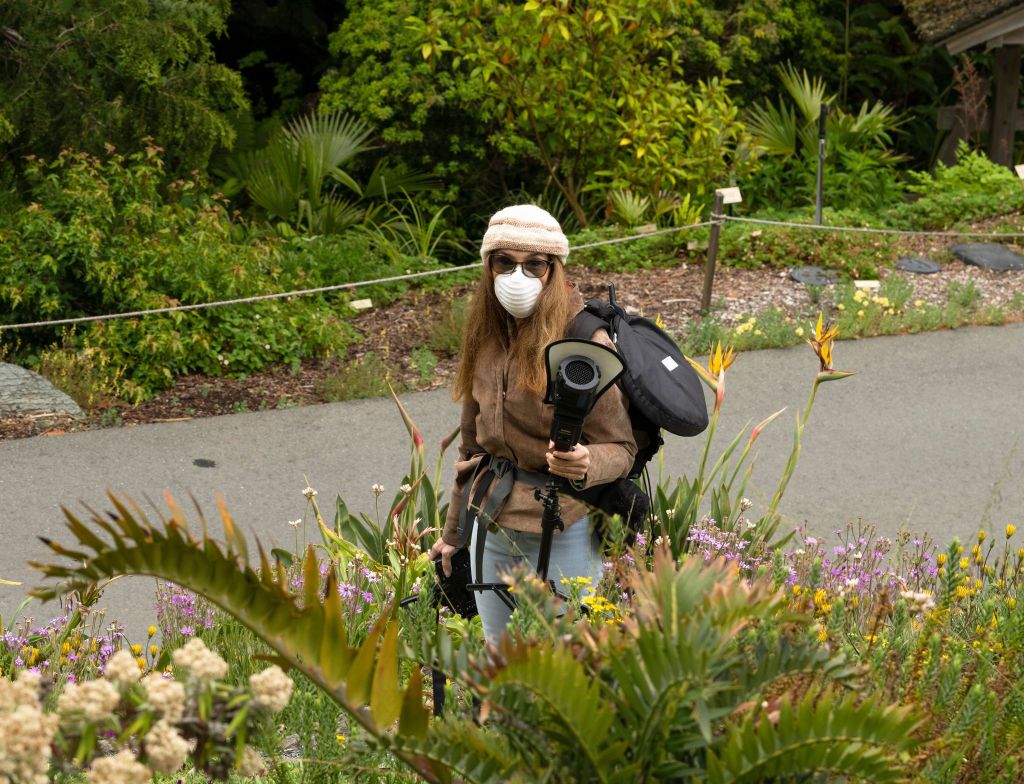
Since many plants were flowering, I didn’t take any chances with the pollen, and used a pollen mask. The photo below is a courtesy from my friend Beth, who went with me.
The technique to obtain the Featured Photograph
The FEATURED PHOTOGRAPH (f/13, 1/1250, ISO 640) portrays Echinopsis chiloensis, a cactus from low altitudes in Chile. I took it with the 105 macro Nikon on my DSLR, handheld.
This was the first time I went to a garden for botanical photography without my tripod. The 105 mm macro is difficult to use in the field because the shutter speed needs to be at least 1/200 s to produce a sharp picture when handholding the camera. On overcast days, which are ideal for botanical photography, there is often not enough light to use the native ISO 100 and a fast shutter speed. But I figured that post-processing programs are getting better and better, which frees me to use a higher ISO and still obtain a final product that is free of noise.
Besides using a high ISO, I also underexposed the featured image, resulting in a photograph that is overall dark except for the flower, which seems to burst with light. A pleasing effect. The abundance of light emanating from the flower allowed me to use a very high shutter speed (1/1250) at ISO 640 combined with an acceptable aperture for the effect I was trying to get.
Prints of the FEATURED PHOTOGRAPH are available for purchase in my GeoGalleries site.
______________________________
Wall Art landscapes and miscellaneous
________________________________


 It is all about the light
Leave a reply to Steve Gingold Cancel reply