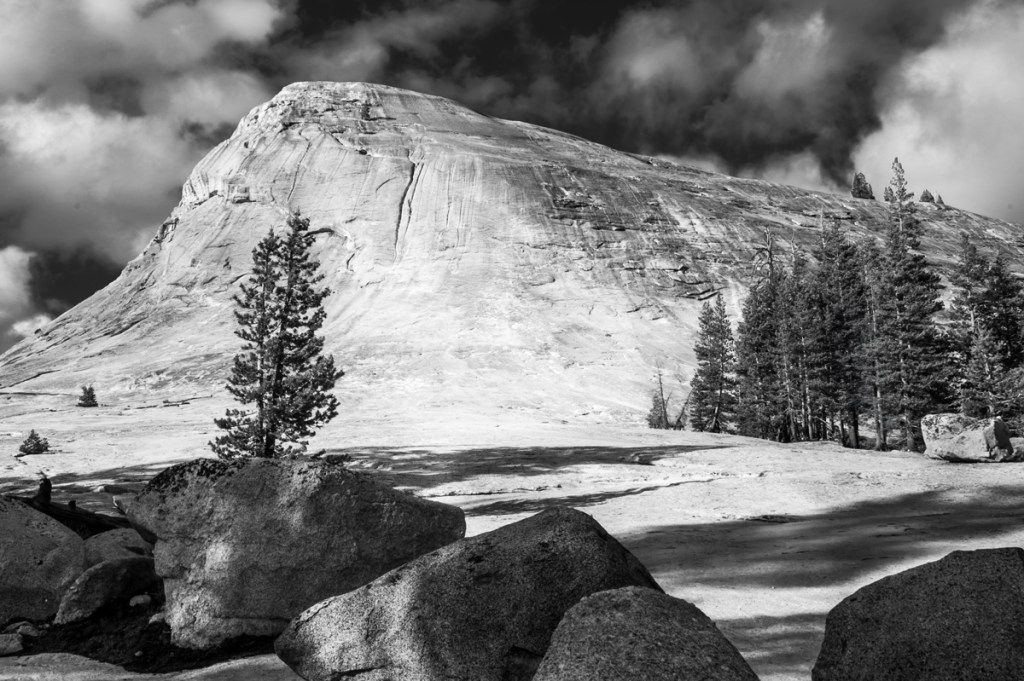
Lambert Dome in black and white-Yosemite National Park

Published by

on

It has been a while since I last went out specifically for photography. The reasons are varied. I’ve developed other interests, I haven’t had as much time or mental energy, and, of course, there is summer. Work has also been a little stressful lately, with pest outbreaks keeping my mind occupied long after I leave the office. (I am an entomologist, after all.) By the time I get home, the day often continues to play in my head, leaving little room for photographic inspiration.

And then there is AI.

The rapid development of generative AI has made it remarkably easy for anyone to produce beautiful, technically flawless images in seconds. Sometimes I find myself wondering: what’s the point? Why spend hours traveling, hiking, waiting for the right light, and carrying heavy equipment to take a beautiful photo when any crappy photograph can be made beautiful in seconds?

I don’t really have an answer to that question yet.

But I do know that I still bring my camera with me whenever I go climbing: my newest addiction. And when an opportunity presents itself, I take a photograph. Maybe that is enough for now: photography not as the primary purpose of the trip, but as something that accompanies me, waiting for those moments when I see something worth stopping for.

The featured photograph was taken in Tuolumne, in Yosemite National Park, the last time I actually set out with photography in mind. I had signed up for a wild horse photography workshop, but the workshop was unexpectedly moved to a weekday. Since I already had reservations in the Eastern Sierra, I decided not to waste the trip. Instead, what was supposed to be a photography adventure quickly turned into a climbing adventure.

Climbing in Tuolumne, however, turned out to be considerably more challenging than it initially appeared. The approaches were long and strenuous, the routes had few bolts to clip in the rope, and there was plenty of intense sun and wind. It was a very different kind of adventure from the one I had originally planned.

And somewhere in the middle of all that climbing, I managed to take a photograph of Lambert Dome.

See the prominent crack running up the rock? That is actually a climbing route. It has one bolt in the middle to clip the rope.

Needless to say, it was a definite no-no for me. I like my climbing adventures with a little more protection than that.

But I do like the photograph.

Perhaps that is the point after all. Photography may not always need to be the reason I go somewhere. Sometimes it can simply be the unexpected reward for being there.
______________________________

Wall Art Botanical Images

Wall Art Photography projects

Wall Art landscapes and miscellaneous

________________________________

6 responses to “Lambert Dome in black and white-Yosemite National Park”

  1. Steve Schwartzman Avatar

    Ah yes: AI. Some photographers now claim that the photographs they come up with via AI are really their own because of the initial prompts they give it and the follow-up prompts with which they have AI refine the initially generated image. I’m not buying that, and, from what you’ve said, neither are you.

    Out of curiosity, I just asked AI this question: “What percent of photographers accept an AI-generated image as a real photograph?” The answer I got was:

    “There is no specific statistical percentage tracking how often professional photographers themselves are personally fooled into accepting an AI-generated image as a real photograph. General public and consumer studies show people misidentify AI images as real roughly 17% to 43% of the time depending on viewing duration, while photographers have a much higher baseline skepticism and technical eye for artifacts.”

    The answer continued:

    “83% of photographers use artificial intelligence in some capacity in their workflow, according to a study shared by VSCO. 68% of professionals use AI tools at least on a weekly basis. 64% of photographers report that their clients do not even notice or mind when AI tools are utilized during post-processing or cleanup.”

    “Ethical rejection: While photographers embrace AI for administrative tasks, culling (e.g., sorting via software like Aftershoot), and non-destructive retouching (like Adobe’s Generative Fill), they strictly reject fully synthetic text-to-image outputs as “real photographs” in professional or documentary contexts.”

    “The 58% impact: According to the Association of Photographers, 58% of working commercial photographers report losing traditional commissions because clients opt for cheaper generative AI alternatives instead of hiring a real shoot.”

    So things do seem to be moving rapidly toward AI.

    Liked by 1 person

    1. Alessandra Chaves Avatar

      I agree with those points made by AI. It’s sad that generative AI is replacing photo shoots. People now can take their own photos and make them look professional using AI… and yes it’s becoming difficult to distinguish videos and photos that are AI generated from real ones.

      Like

  2. shoreacres Avatar

    Lambert Dome reminds me of a large pile of freshly churned butter: taken from my grandmother’s churn with her wooden butter paddle, then plopped onto a plate to be divided and smoothed. That butter paddle now hangs on my kitchen wall.

    Liked by 1 person

    1. Alessandra Chaves Avatar

      An interesting comparison I had not thought about.

      Liked by 1 person

  3. tierneycreates: a fusion of textiles and smiles Avatar

    I’ve joked in the past about letting my inner Ansel Adams run free and taking B&W nature photographs, but you have a real Ansel in there! Amazing image! I never thought about the AI competition that professional photographers can face. I hope that people will continue to want the authentic human eye and continue to support this human art!

    Liked by 1 person

    1. Alessandra Chaves Avatar

      I hope that too….

      Liked by 1 person

Leave a comment

Discover more from It is all about the light

Subscribe now to keep reading and get access to the full archive.

Continue reading