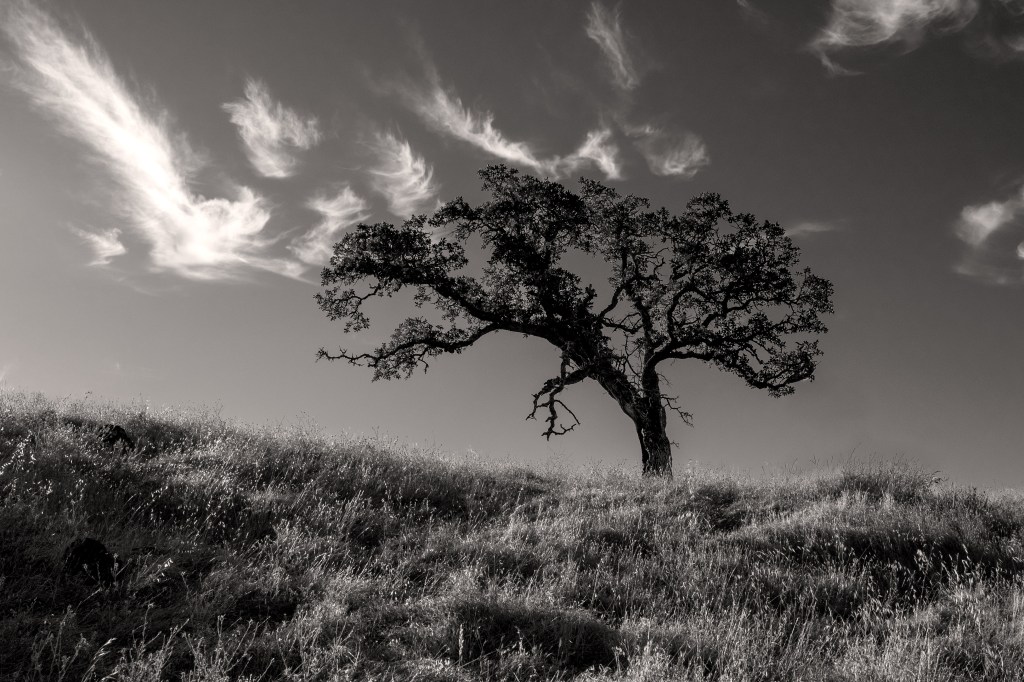
There is something universally compelling about a lone tree. Whether growing on a windswept hill, standing beside a quiet lake, or surviving in the middle of an open plain, a solitary tree naturally draws the eye. In landscape photography, few subjects are as effective at simplifying a composition while adding emotional depth.
The power of a lone tree lies in its isolation. Our eyes are naturally attracted to subjects that stand apart from their surroundings. A single tree surrounded by empty space immediately becomes the visual anchor of the photograph. Instead of competing with dozens of other elements, it commands attention, allowing the viewer to appreciate its shape, texture, and character.
Every lone tree has its own personality. Some are perfectly symmetrical, their branches spreading gracefully against the sky. Others are twisted by decades of wind, drought, lightning, or snow, creating sculptural forms that seem to tell the story of a lifetime. These unique silhouettes become especially striking at sunrise or sunset, when low-angle light emphasizes the intricate network of branches and casts long shadows across the landscape.
Composition plays a critical role in photographing isolated trees. While placing the tree in the center can emphasize symmetry and strength, positioning it off-center often creates a more dynamic image. The surrounding landscape should not simply be treated as empty space; it provides context and balance. Rolling hills, distant mountains, textured grasslands, or even a dramatic sky all contribute to the story while reinforcing the tree as the primary subject.
Black-and-white photography is particularly well suited to lone trees. Without the distraction of color, the viewer’s attention shifts to form, texture, contrast, and light. The graphic quality of bare branches against a bright sky or the rough texture of deeply furrowed bark becomes more apparent. Monochrome images often emphasize the timeless nature of these subjects, allowing emotion to emerge from simplicity rather than color.
Perhaps the greatest appeal of photographing lone trees is their ability to tell stories without words. They invite viewers to imagine decades—or even centuries—of changing seasons, harsh weather, and quiet resilience. They remind us that beauty often exists in simplicity and that a single subject, thoughtfully observed, can carry extraordinary visual and emotional impact.
The next time you encounter a solitary tree, resist the urge to treat it as just another landscape element. Walk around it. Observe how its shape changes from different angles. Wait for the light to evolve. In doing so, you may discover that one tree is enough to tell an entire story.
If you want to see my Lone tree collection, I click on this link.
______________________________
Wall Art landscapes and miscellaneous
________________________________


Leave a comment