On January 15, 2024, I decided to spend another day looking for photographs for my project on California’s “Central Valley”. This time, I chose the Gray Lodge Wildlife Area. My first post in this series was about my visit to the Sacramento National Wildlife Refuge and the second was about visiting the Colusa National Wildlife Refuge.
As I explained in my previous post, nestled inside Northern California’s Central Valley lies a haven that plays a pivotal role in the survival and sustenance of countless migratory birds—the Sacramento National Wildlife Refuge Complex (SNWR). Spanning over 10,000 acres, this refuge serves as a critical habitat for migratory birds along the Pacific Flyway, welcoming flocks of waterfowl, shorebirds, and raptors throughout the year. One of the units of the complex is the Gray Lodge Wildlife Area (GLWA).
Encompassing an expansive area, the GLWA spans over 9,100 acres, providing a crucial sanctuary for a diverse range of migratory birds. Nestled within the Pacific Flyway, one of North America’s major migratory routes, Gray Lodge plays a pivotal role in supporting the journey of countless waterfowl and shorebirds. Its expansive wetlands, seasonal marshes, and riparian habitats create a rich mosaic that attracts an array of avian species. The area is not only renowned for its sheer size but is also recognized for its importance as a resting and feeding ground during the birds’ long journeys.
The FEATURED IMAGE
It was so foggy when I approached the Gray Lodge Area that I might not have gotten there wasn’t for the GPS. At first, I thought I had wasted my time, but as I traversed the auto-tour, I began to see, here and there, a few photos. There were few birds and they weren’t doing much of anything.
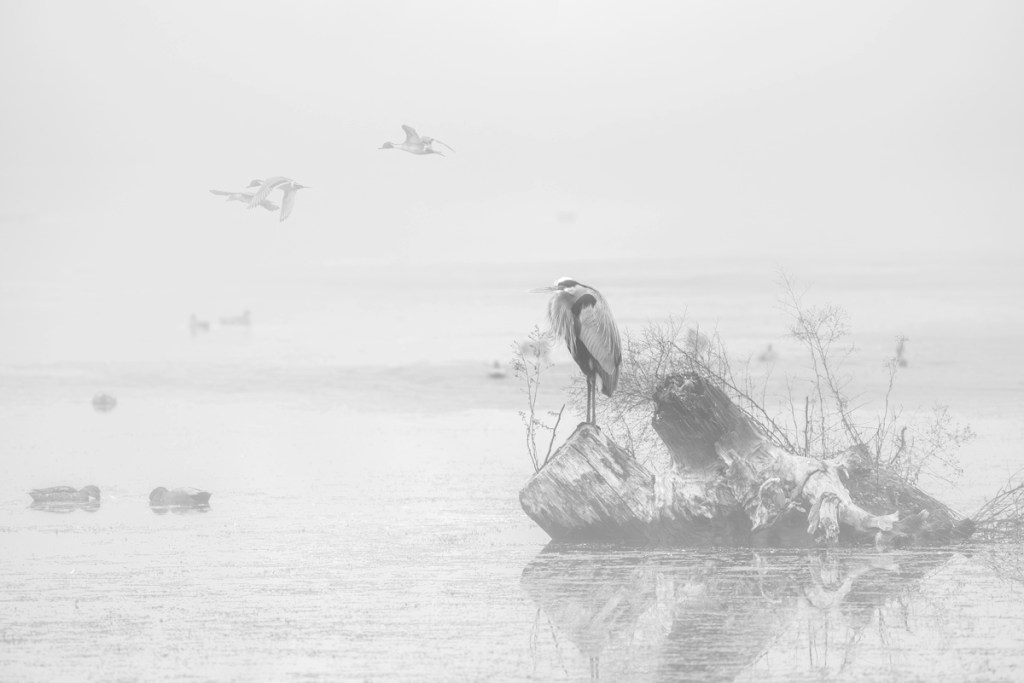
The FEATURED IMAGE ( f/5.6, 1/2000 ISO 640 @340mm), repeated below for convenience, portrays a quiet Great Blue Heron and a few ducks and flying geese in the background, amidst very dense fog. Dense fog is a characteristic of the Central Valley in the winter. I like the mystery and quiet of this photograph.
Click on the image below to enlarge.

Similar to my first post in this series, the featured image is a double exposure, with the second exposure capturing three flying geese. These geese not only introduce dynamism to the frame but also serve to balance it. Balance in composition is a crucial principle in art and design, ensuring overall harmony and visual appeal. Achieving balance involves distributing elements within a piece to create equilibrium and stability. Initially, the composition had an imbalance due to the empty sky and heavier elements on the right side. The flying geese, forming a diagonal with the bird and logs, help to ameliorate and distract from this imbalance and ads some dynamic visual interest.
Conclusion: The SNWR Complex and my project “Central Valley”
The SNWR is a remnant of a much greater marsh area that covered a great portion of the Central Valley north of the Sacramento Delta. Although now greatly reduced, this area is one of the few places where the original ecosystem of the area can be seen and photographed.
I want to go back to the Gray Lodge eventually to take more photographs for my Central Valley project, but I am not sure that it will happen this year. If I can still make it in February, I’ll give it a try.
______________________________
Wall Art landscapes and miscellaneous
________________________________


 It is all about the light
Leave a comment