
On January 6, 2024, I decided to spend another day looking for photographs for my project on California’s “Central Valley”. This time, I chose the Colusa National Wildlife Refuge as my place to visit.
As I explained in my previous post, nestled within Colusa County lies a haven that plays a pivotal role in the survival and sustenance of countless migratory birds—the Sacramento National Wildlife Refuge Complex (SNWR). Spanning over 10,000 acres, this refuge serves as a critical habitat for migratory birds along the Pacific Flyway, welcoming flocks of waterfowl, shorebirds, and raptors throughout the year. One of the units of the complex is the Colusa National Wildlife Refuge (CNWR).
The CNWR stands as a serene sanctuary for diverse flora and fauna. Encompassing over 4,500 acres, this refuge boasts an impressive array of wetlands, grasslands, and riparian habitats. The refuge’s strategic location and thoughtful management make it a prime spot for birdwatching and wildlife photography. Visitors can traverse the refuge’s trails and observation points, immersing themselves in the natural beauty while gaining a deeper appreciation for the delicate balance of ecosystems sustained within this protected haven. There is also an auto-tour that allows visitors to photograph the birds without chasing them away.
The FEATURED IMAGE
The FEATURED IMAGE ( f/5.6, 1/1250s ISO 280 @200mm), repeated below for convenience, is an overview of the landscape at the entrance of the refuge. The mountains in the background are the Sutter Buttes. Right before sunset, a number of cars lined up at this spot, from which photographers waited for the birds to lift flight in large groups. That never happened, and very quickly the landscape in front of the mountains was in the dark, as the sun set.
Note that only a tiny fraction of the frame is in sharp focus, a result of the optics associated with tele-photo lenses. Although I could have stepped down the lens to f/11 or so while cranking the ISO, the additional depth of field would probably not be worth the while.
Click on the image to enlarge it.
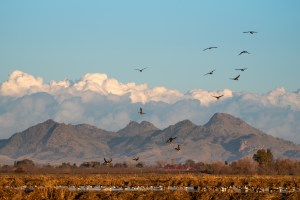
None of my photos from the CNWR look good in black and white. Still, I wanted to show the landscape to my followers . While I take the liberty to compose and modify black and white photographs at my will, I am reluctant to do so in color. After all, there IS a color world and photographing it means telling the story of what is. The featured photo, consequently, is pretty much as it was seen, except for some distracting elements and out of focus birds that were cloned out.
A bonus sighting
Near the exit, however, I was greeted by a marvelous Red-Tailed Hawk. They are very common around here, in fact I don’t need to go anywhere far from my home to see or photograph one. I snapped a shot of it with my 200-500 mm f/5.6 at 500mm, f/5.6, 1/1250s, ISO 125. The main challenge when photographing these angry-looking raptors is to find an angle without any twigs in front of them. This can be difficult if you cannot get out of your car.
Click on the photograph below to expand.

Conclusion: The SNWR Complex and my project “Central Valley”
The SNWR, in the heart of Colusa County amidst the fields and wetlands, is a remnant of a much greater marsh area that covered a great portion of the Central Valley north of the Sacramento Delta. Although now greatly reduced, this area is one of the few places where the original ecosystem of the area can be seen and photographed.
The Colusa National Wildlife Refuge may not be the most ideal place to take photographs for my Central Valley project unless I find stronger compositions to render in black and white. While I plan to eventually come back to this place, I will move on to another sanctuary on my next outing.
______________________________
Wall Art landscapes and miscellaneous
________________________________


 It is all about the light
Leave a reply to Alessandra Chaves Cancel reply