
If you don’t live in or near California, you may not have heard about our drought, and our relentless wildfires, which now start sometime in the beginning of the summer and only end with the first rains, sometimes well into October. These fires typically affect the chaparral scrubland of the lower elevations, but they have become more frequent and more intense in the Sierra Nevada, where the well-known Yosemite National Park is located.
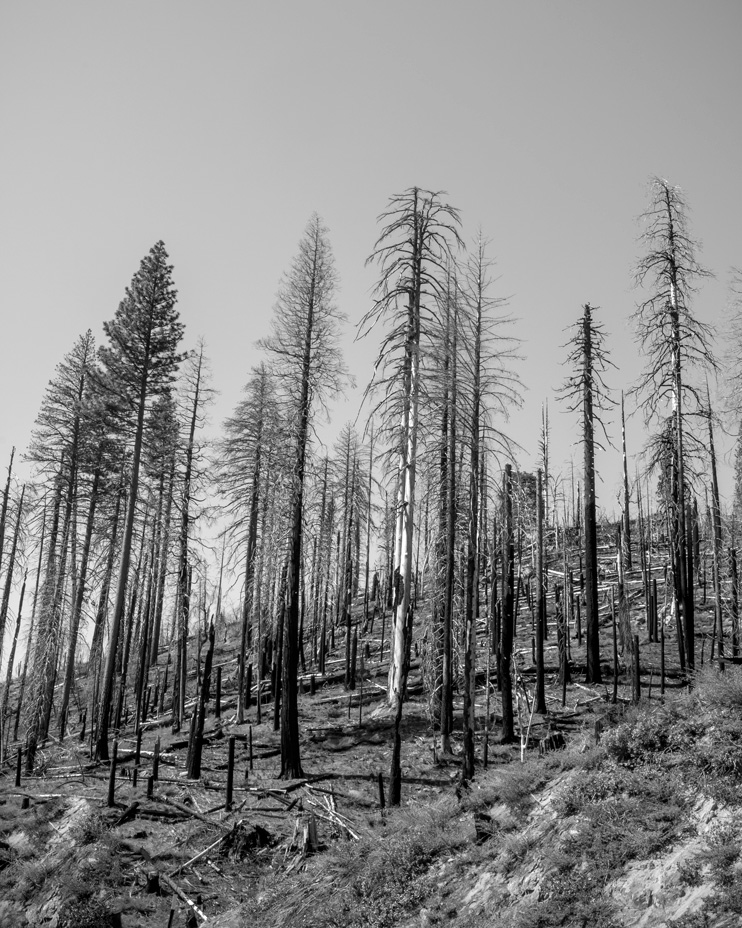
Although I have been to Yosemite some five times since I moved to California fifteen years ago, I still remember how highway 120, one of the access roads to the park, looked on my first trip: a lush green coniferous forest. It now has been replaced, in many areas, by a charcoal wasteland. Last time I went up to the park following 120, back in the beginning of April of this year, I took the time to stop and take a few snapshots of the destruction (see featured image).
What happened in Yosemite?
BARK BEETLES AND WILDFIRES
Native bark beetles kill many trees in California, but the level of damage they cause is primarily influenced by tree density (trees in dense groups are more vulnerable to bark beetle infestation) and forest health. In and around Yosemite, we have a combination of densely packed conifer trees, and poor forest health resulting from several years of water deficit and poor forest management. Diseased and dead trees, from beetle attacks, are a great fuel for wildfires which, in Yosemite, are often ignited by lightening. The fires spread very fast among the dead trees, also killing, and burning the healthy trees on their path.
Bark beetles bore through the tree bark to lay their eggs in the inner bark. They feed on the living tissue of the tree, cutting off its ability to transport nutrients. The pattern on the underside of the bark, created by the feeding of these insects, is characteristic of each species. Good photos of beetle galleries can be seen o this post by fellow blogger Steve Schwartzman. I took the photo below in Yosemite.

One clue that a tree has been infested by bark beetles is woodpecker holes. Woodpeckers make holes in the trunks to find food and eat the larvae that are beneath the surface of the tree bark. This time in Yosemite, I witnessed several Douglass Fir pine trees with many woodpecker holes on them.

Most likely, we will end this spring in another water deficit. The snowpack in Yosemite this year is about 64% of its long-term average amount. I am not looking forward to another summer of wildfires in the Sierra Nevada, but it looks like we are on our way to it.
______________________________
Wall Art landscapes and miscellaneous
________________________________


 It is all about the light
Leave a comment