Last Saturday I was out climbing in Lover’s Leap. There hasn’t been a lot of snow there this year and for the most part snow has been gone for about four weeks.
I fell! Trying to climb down on lead after trying to reach a stuck rope end, and relying on one cam for protection, I stepped on moss, and my foot slipped! Fortunately the cam didn’t pop and my belayer was able to catch me, but since the slope wasn’t completely vertical, I hit the rock! The rock was hard, but I am fine.
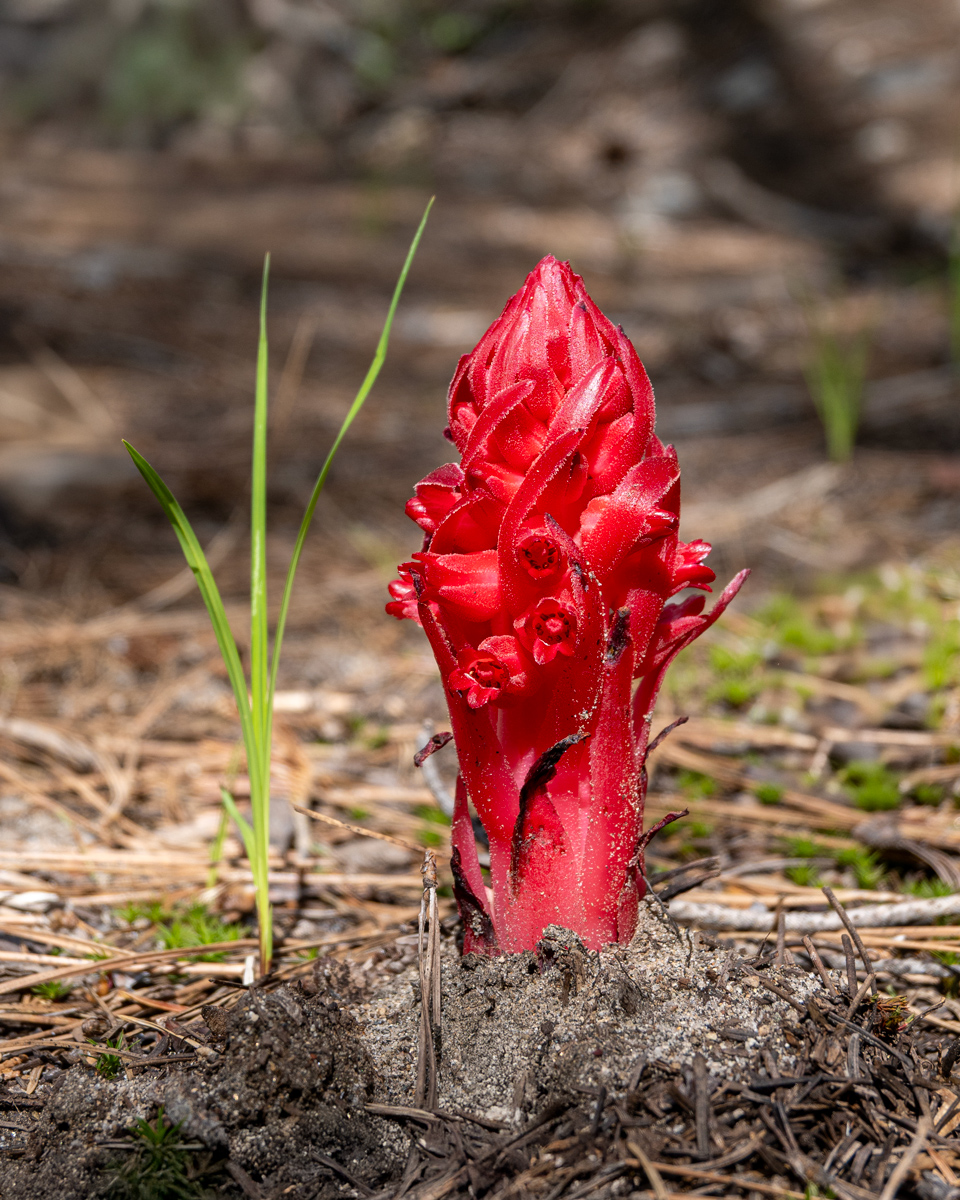
As usual when I go climbing, I wasn’t prepared for macro photography, carrying only my Z-50 with the kit lens. On the way out, I had the pleasure to spot a Snow Plant on the ground, next to the river.
Few plants look as otherworldly as the snow plant, a striking crimson wildflower that emerges from the forest floor like a flame after the winter snow melts. Found in the mountain forests of the western United States, including the slopes of the Sierra Nevada, the snow plant (Sarcodes sanguinea) thrives beneath towering pines and firs. Despite its vivid appearance, it contains no chlorophyll and cannot photosynthesize like most plants.
Instead, the snow plant survives through a fascinating underground partnership. It connects to fungi in the soil, which in turn are linked to nearby trees. Through this hidden network, the plant receives nutrients without ever producing its own energy from sunlight. This unusual lifestyle makes it part of a rare group of parasitic or mycoheterotrophic plants.
The snow plant’s deep red color and waxy texture make it a favorite subject for photographers and hikers alike. It often appears in spring and early summer shortly after snowmelt, adding a dramatic burst of color to otherwise muted forest landscapes. Because the plant is delicate and slow-growing, visitors are encouraged to admire it without picking or disturbing it.
For many people exploring the mountains of California, spotting a snow plant is a reminder that forests are filled with hidden relationships and remarkable adaptations waiting just beneath the surface.
A parasitic plant?
In many places on the web the Snow Plant is referred to as a parasitic plant. The snow plant, Sarcodes sanguinea, does not directly parasitize trees in the way mistletoe or dodder do. Instead, it is considered mycoheterotrophic , i.e. it obtains nutrients through a relationship with underground fungi that are themselves connected to tree roots.
In older or simpler descriptions, people often call it “parasitic” because it ultimately depends on other organisms for carbon and nutrients. But botanists usually prefer the more precise term “mycoheterotrophic” since the snow plant is specifically exploiting fungal networks rather than attaching directly to a host plant.
______________________________
Wall Art landscapes and miscellaneous
________________________________


 It is all about the light
Leave a comment