
On December 31, 2023, I decided to spend my day looking for photographs for my project on California’s “Central Valley”. Instead of heading to Fairfield, where I usually look for landscapes, I decided to go north to Colusa County.
Nestled within Colusa County lies a haven that plays a pivotal role in the survival and sustenance of countless migratory birds—the Sacramento National Wildlife Refuge Complex (SNWR). Spanning over 10,000 acres, this refuge stands as a testament to the commitment towards preserving critical habitats.
Surrounded by agricultural fields, the SNWR offers a stark contrast to the meticulously cultivated landscapes of the region. Here, amid the fertile grounds of the Central Valley, lies a mosaic of wetlands, ponds, and marshes—an oasis for migratory birds on their awe-inspiring journeys. From fall to spring, millions of birds travel along the Pacific Flyway, undertaking arduous journeys that span thousands of miles. For many, this refuge serves as a vital stopover—a place of respite where they can rest, refuel, and replenish their energy reserves.
Limitations of tele-zoom lenses and wildlife photography
The day was dark and rainy. Although a partly overcast day is good for wildlife photography, a dark day presents a number of problems, particularly if one is using a telephoto zoom lens.
It is common to see tele-zooms with an f/4.5-6.3 or so maximum aperture, meaning that the lens can open up to f/4.5 at the widest focal length and only f/6.3 at the longest focal length. Such lenses have reduced weight and a smaller form factor, and are generally cheaper than the fixed aperture telephotos or telephotos that open to f/2.8. For example, the Nikon 180-400 mm f/4 costs a little over 12,000 dollars, whereas the 200-500 mm f/5.6 costs approximately 1,300. The fastest telephoto from Nikon, one that will open to f/2.8, has a maximum focal length of 300 mm, and not really enough for bird photography. And it costs roughly 9,500 dollars!
In view of the optical and financial limitations, most photographers need to feel satisfied with a telephoto that is not very fast and only opens to f/5.6. For that reason, a dark day is not to the wildlife photographer’s advantage. Light is needed for this type of photography.
Since I was mostly looking for wider views, and the day was dark and foggy, I headed out carrying only a 24-70 mm f/2.8 and a 70-200 mm f/2.8. Although the latter is an excellent lens, its focal length is not adequate for wildlife photography.
The FEATURED IMAGE
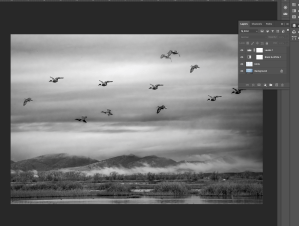
The FEATURED IMAGE is a composite of a photograph of the landscape with another photograph, taken immediately after, of the birds traversing it. For this type of composition to work, I used the same camera, lens and focal length (70-200mm f/2.8 @200mm). The landscape photo was taken at f/11, 1/400, ISO 800, and the photo of the birds, a few seconds after, at f/3.2, 1/4000s, ISO 800. Being able to open up the lens helped get a lot of light in so I cold have a fast shutter speed to congeal the birds in flight.
To compose the image I layered the birds over the landscape and changed the blending mode to “darker color”. I then converted the image to black and white using an adjustment layer and fixed the levels with another adjustment layer. Click on the image below to expand.
A bonus sighting at the exit
It started raining and since there were few birds in the sanctuary that day, I decided to cut my day short. Near the exit, however, I was greeted by a marvelous Bald Eagle. Only then I regretted not bringing a telephoto. I snapped a shot of it with my 70-200, and after cropping and reducing the printable photo a 6X6″, I arrived a close-enough view, which I present below.
Click on the photograph below to expand.

Conclusion: The SNWR Complex and my project “Central Valley”
The SNWR, in the heart of Colusa County amidst the fields and wetlands, is a remnant of a much greater marsh area that covered a great portion of the Central Valley north of the Sacramento Delta. Although now greatly reduced, this area is one of the few places where the original ecosystem of the area can be seen and photographed.
I plan to visit the complex a few times this winter, as well as other migratory bird sanctuaries in my areas, to complement my project.
______________________________
Wall Art landscapes and miscellaneous
________________________________


 It is all about the light
Leave a reply to Alessandra Chaves Cancel reply