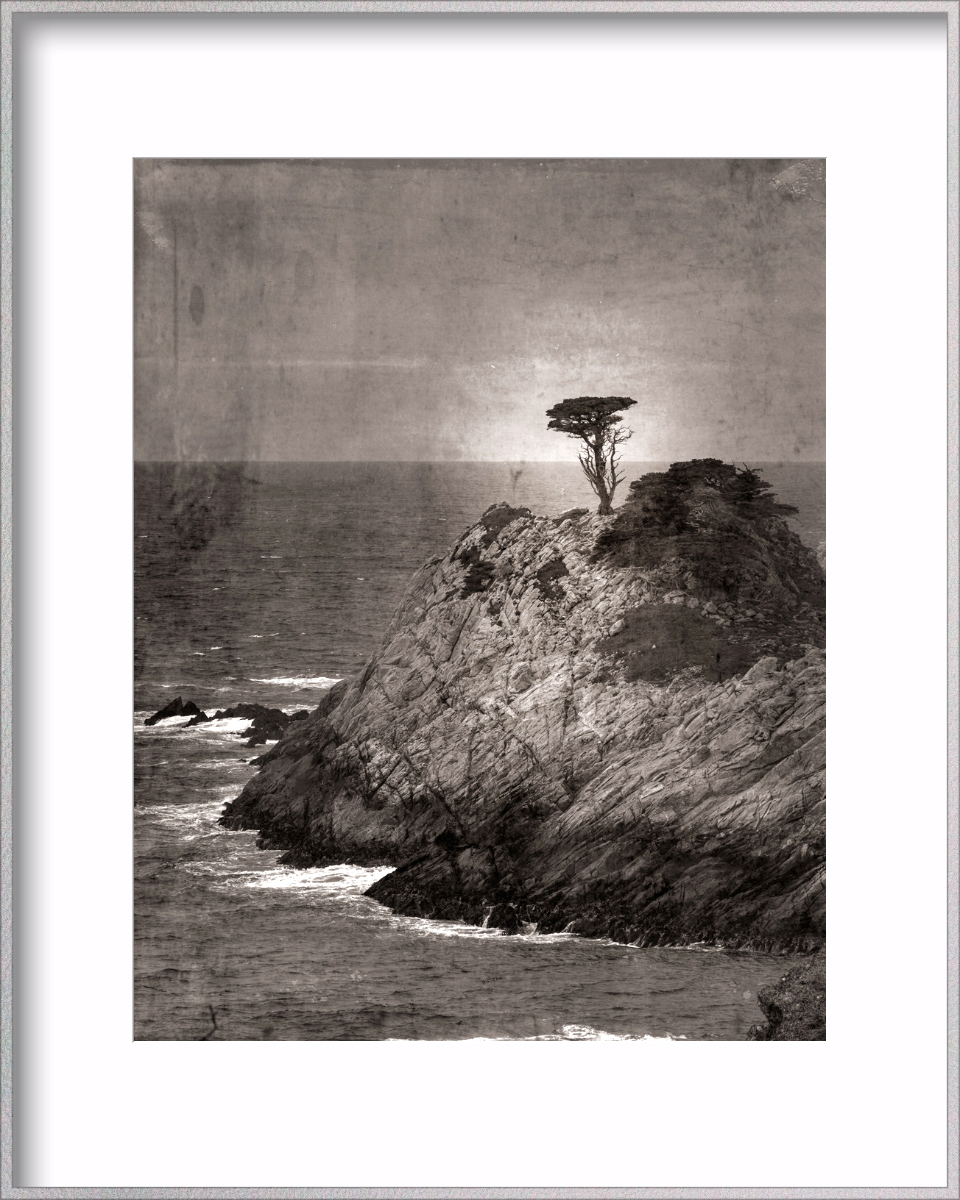
Monterey Trees, part two- resilience

Published by

on

In the beginning of February, I spent two days in Monterey, where I took three photographs to be included in my small Monterey Trees series. One of them is the featured photo. I took it at Point Lobos SNR, and named the image “Lonely Cypress, 2022“.

I wrote a previous blog post (Monterrey Dreaming) about Monterey Trees, where I explain in more detail how I process my photos, and how they deviate from my usual work in that I apply a texture and a tone to my images.

RESILIENCE

The Monterey Trees series is centered on the concept of resilience. According to the American Psychological Association, “Psychologists define resilience as the process of adapting well in the face of adversity, trauma, tragedy, threats, or significant sources of stress…As much as resilience involves “bouncing back” from these difficult experiences, it can also involve profound personal growth.”

The conditions in Monterey County are harsh on trees. The relentless wind, thin soil, and salt from the ocean, are challenges that the Monterey Cypress, among other local trees, have adapted to in the course of their evolutionary histories. More recently, the resilience of these local trees has been further challenged by drought, bark beetle infestations and urbanization, all of which have contributed to the death of many cypresses. Sadly, scientists have predicted that most of the still living Cypress trees of Monterey will be dead within the next 20 years.

Urbanization, or should I say, poor urban planning, is a common culprit in other types os environmental disasters. On the 15th of February, a very heavy rain followed by landslides partly destroyed the imperial city of Petrópolis. That’s about 20 miles from where my family has a house. Although it is not possible to control the volume of rain in the tropics, lots of problems can be avoided if the rainforest trees are left alone, since they are responsible for holding the thin layer of soil on the Atlantic slopes. Many people lost everything plus loved ones in this recent incident, and I wish that they have the resilience necessary to recover from this tragedy.

Another tragedy that happened in February, and which brings to mind another type of tree, my family tree, was the Russian invasion of Ukraine. My great-grandparents on my mothers’ side fled from Luhansk, or Lugansk (previously known as Voroshilovgrad), in the contentious Donbas region (near the border with Russia). They fled around 1916, to Germany, carrying my grandfather, then a child. A few years later they headed to Brazil. The trauma of experiencing the reality of wars, leaving one’s native land and abandoning loved ones is difficult to overcome. It is sad that almost one hundred years later little seems to have changed. I pray that my Ukrainian friends trapped in Kiev and their children trapped here will find the necessary resilience to deal with the changes brought forth by this horrendous war.

POPULARITY

If social my media feedback is a sample from which I can draw provisional conclusions, my collection of images in Monterey Trees is the least favored by the public. I have fun trying to find more subjects for this project, and figuring out how to properly photograph each one. Throwing your work out there to risk having it rejected is not easy, and every artist, wether publicly acclaimed or self-proclaimed, needs a good deal of resilience to persevere, and courage to learn and grow from one’s failures.

TEST PRINTS

The test prints for this series look beautiful on Hahnemühle papers with a warm tone and some texture. A fellow blogger (thank you, Howard) did a test print of one for me on Hahnemühle Museum Etching, which I liked very much. But since this paper is not widely available, I tested-printed a few of the other photos on Hahnemühle William Turner, Photo Rag, and also on canvas. They all look excellent to me.

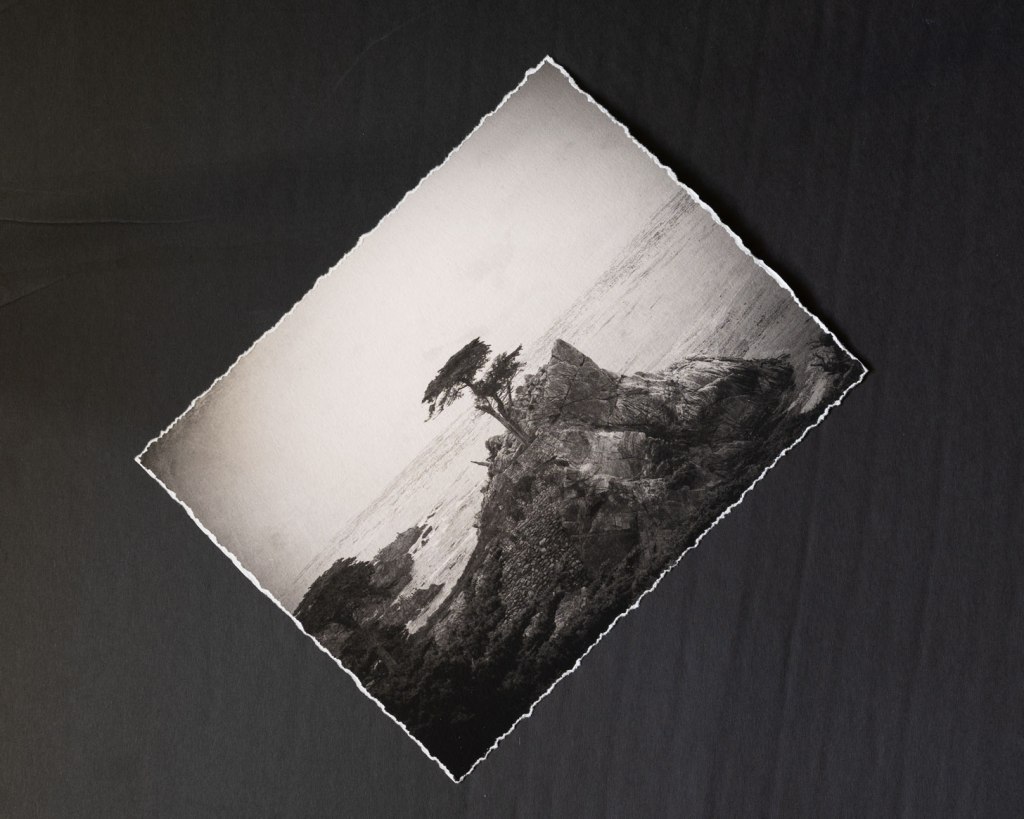
I ordered one print sample on William Turner with deckled edge. I wanted to see how it looks like. I like the finish and I think that it agrees well with the “spirit” of the collection. The problem is, I am not sure how to prepare it to hang. On the Fireworks website (where I order my prints from), it says that this finish “is ideally suited if you are planning to display your print floated inside matting and a frame or even a shadow box.” Well, I have never seen this type of finish matted and framed. But, it’s super cool 😎
Click on the link to see the rest of my Monterey Trees image series.

RESOURCES

A follower posted a comment with a link, on my last post about Monterey Trees. The link is to a poem (with an accompanying picture) in a magazine, published in 1914, about a windswept tree in WY. I’m happy to know that a century ago someone saw what I see in those trees.

If you want to learn more about the Monterey Cypress, an endangered species, there is a good article on Wikipedia.

I have a few previous posts about photography projects and series, where I discuss the possible benefits of working that way and some difficulties I have encountered in my own work.

______________________________

Wall Art Botanical Images

Wall Art Photography projects

Wall Art landscapes and miscellaneous

________________________________

17 responses to “Monterey Trees, part two- resilience”

  1. Vistaphotography - Jeff Foliage Avatar

    Lovely scene on the coast…

    Like

    1. Alessandra Chaves Avatar

      It does contrast with the full parking lot from where I took the original photo!

      Like

  2. Steve Schwartzman Avatar

    Time and the vagaries of chemistry have marked many an old photographic print. I’ve long assumed that those markings on what might be called “vintage prints” led to the current use of added textures to impart a sense of age to modern prints, as in this post’s top picture. I’ve also speculated that 19th-century photographers would prefer it if we in the 21st century could see their works in the pure (artifact-free) form they originally intended.

    I’m glad you decided to explain your family’s connection to the region currently being devastated.

    Liked by 1 person

    1. Alessandra Chaves Avatar

      The digital era has made it possible, to preserve original graphic representations. You should see now the Polaroid phots I took when I was a child! I see no end to the war on Ukraine and the potential ramifications that will impact all of us are wide and somewhat unpredictable.

      Like

  3. stuartshafran Avatar

    This is a beautiful series of images, made more so with the added textures. I bet these look fantastic as prints!

    Like you, my grandparents (but on my fathers side) came from Ukraine, but from Odessa in Southern Ukraine. Because it was originally part of USSR my family tree has them marked as Russian, but they never had any affinity for Russia as they also escaped in the early 1900’s but to England.

    The war in Ukraine is a madness. Putin must have thought he could just walk straight in like he did with Georgia and Crimea, but he’s severely underestimated the resolve of the Ukrainians.

    Like

    1. Alessandra Chaves Avatar

      Thank you.
      It is interesting to see just in this blog how many folks have roots in the Ukraine. It breaks my heart to see what’s happening there now! Putin is not the type to admit a mistake, miscalculation or weakness, and that probably means that he’ll run both Russia and Ukraine to the ground. Lots of Ukrainians have family in Russia and vice versa, so basically they are killing their brothers and sisters. Very sad.

      Like

  4. Monterey Dreaming – It is all about the light Avatar

    […] Last week I spent two days at the Asilomar Conference Center in Monterey, where I took the picture above. This is a welcome addition to my small Monterey Trees series, in which I portray live and dead trees found in that County. This collection deviates from my usual work in that I apply a texture and a sepia tone to my images (see under Tips below for details). This post has a follow-up here. […]

    Like

  5. howg2211 Avatar

    I really love the photo….and the texture and toning have really added up in unison to give it a very vintage feel! Looks like a ‘wall-hanger’ to me. And a very nice part of a great collection.

    Like

    1. Alessandra Chaves Avatar

      Glad you like it, Howard. Holy you’re having a great b day!

      Like

  6. shoreacres Avatar

    I couldn’t read the WaPo article about the Petropolis tragedy (paywall), but I found some reports on YouTube, like this one from the BBC. It reminded me of west coast mudslides after fires; in those conditions, rain is good, but too much rain certainly can add to the misery.

    I really like both photos. While we don’t have these specific trees, farther down the coast we do have wind-sculpted coastal oaks that are beautiful. Another place I’ve seen a similar adaptation was in the Arkansas mountains, where the size and shape of mountaintop trees are heavily influenced by the wind. They show their own forms of resilience.

    The tones of the images — would you call them sepia? — are lovely. If your Monterey trees series is least favored by your public, I’d say the ‘fault’ lies not in the images, but in the public. Of course, I found these so appealing I can’t imagine anyone not being attracted to them.

    Liked by 1 person

    1. Alessandra Chaves Avatar

      The video you found is from the place in the mountains where people build houses. These are public lands and should be left to conservation efforts because the soil is thin and what keeps the soil in place there are the tree roots.
      I would love to see the wind sculptured coastal oak trees. Sometimes here in The Valley, along county roads, I see Eucalyptus trees that have grown too one side only, I guess, the direction the wind blows. Too bad they are often intercepted by power lines and poles, it would be closer for me to concentrate on them.
      I am glad you like the series. Peoples tastes vary, but the majority will favor happy compositions in color. It’s only natural, since that’s how people want to see the world…

      Like

  7. Steve Gingold Avatar

    I can’t speak for anyone but myself, which is apparent, but I like this image and how you treated it very much. I also like the one you linked to but this one especially strikes me. We are much better off photographing for our own taste and looking at popularity as a bonus attached to the images we enjoy and are proud of as you should be of this one.These images have special meaning to you so whether anyone else likes them or not doesn’t really matter, in my opinion. Although very different, many of the cedars I see at Acadia N.P. have shapes affected by the winds and winter storms.

    Liked by 1 person

    1. Alessandra Chaves Avatar

      Thank you! It’s true that public appreciation is a bonusband little more. Maybe you show us the cedars at Arcadia one day!

      Liked by 1 person

      1. Steve Gingold Avatar

        Although not shaped by the sea, this is probably the most interesting cedar I’ve found. It certainly makes one wonder.

        Like

      2. Alessandra Chaves Avatar

        Interesting shape for a trunk.

        Like

      3. Steve Gingold Avatar

        It’s a mystery for sure.

        Like

  8. Big names, Small Art auction – May 10 – June 4, 2022 – It is all about the light Avatar

    […] series, focused on the concept of Resilience. In two previous blog posts, Monterey Dreaming and Monterey Trees, part two – resilience, I write about my motivation for this series and explain the technique I use to give the images a […]

    Like

Leave a reply to Big names, Small Art auction – May 10 – June 4, 2022 – It is all about the light Cancel reply

Discover more from It is all about the light

Subscribe now to keep reading and get access to the full archive.

Continue reading